Nematia Technologies Nematia Technologies

From the injection mould to the solar field.

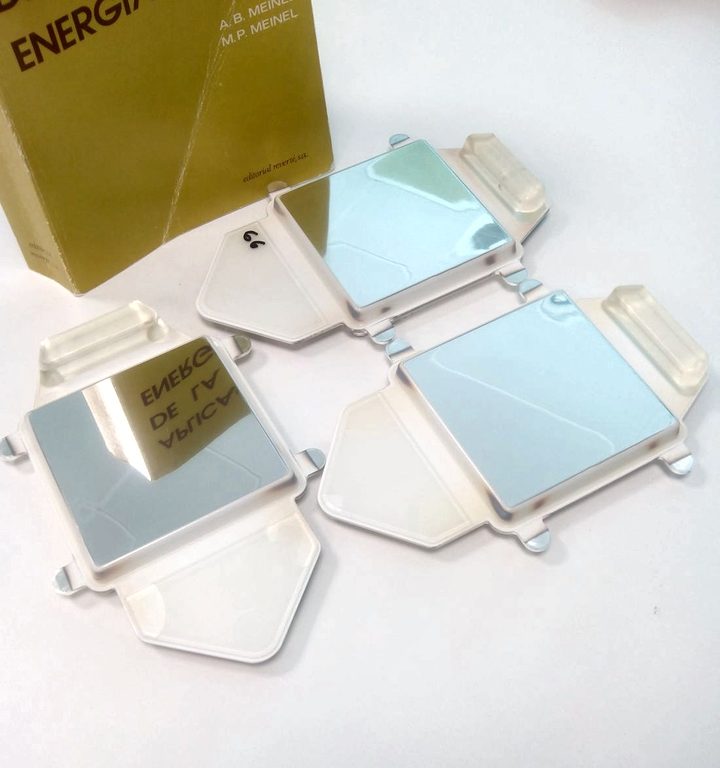
We are a family-run, technology-based microenterprise from Jaén (Spain). We have experience in advanced materials, technical plastics processing and optics applied to solar energy, automotive lighting and other sectors. We started in 2006 as a product and tooling design engineering firm. We then created REFLEXIS, an injection-moulded plastic solar mirror incubated by Fundación Repsol, and in the European project IN-POWER we led its evolution into a polymeric mirror that was installed in a solar thermal pilot plant in Seville. Here we tell our story and show our technology.

If you are interested in our developments, write to us. We are looking for an industrial partner or an investor to take them to market.

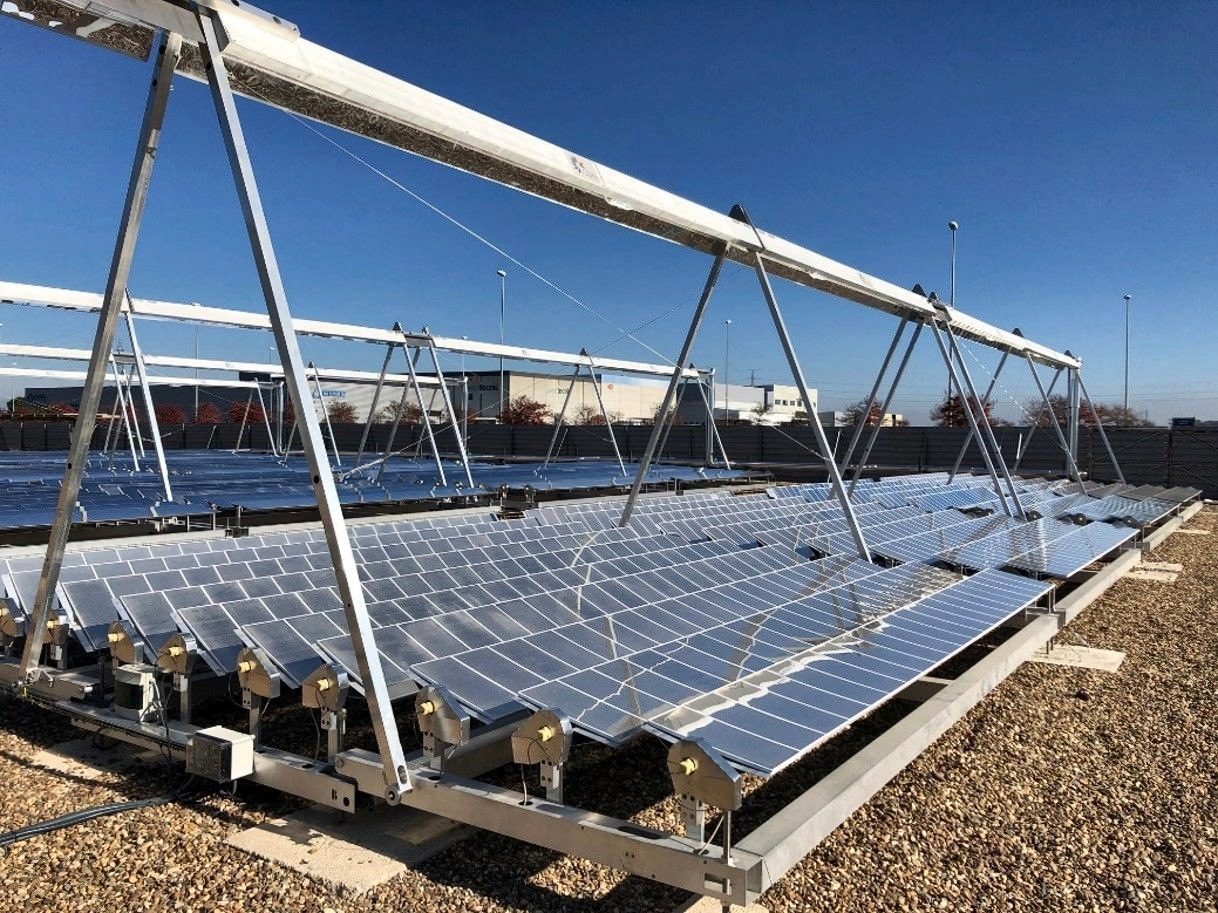
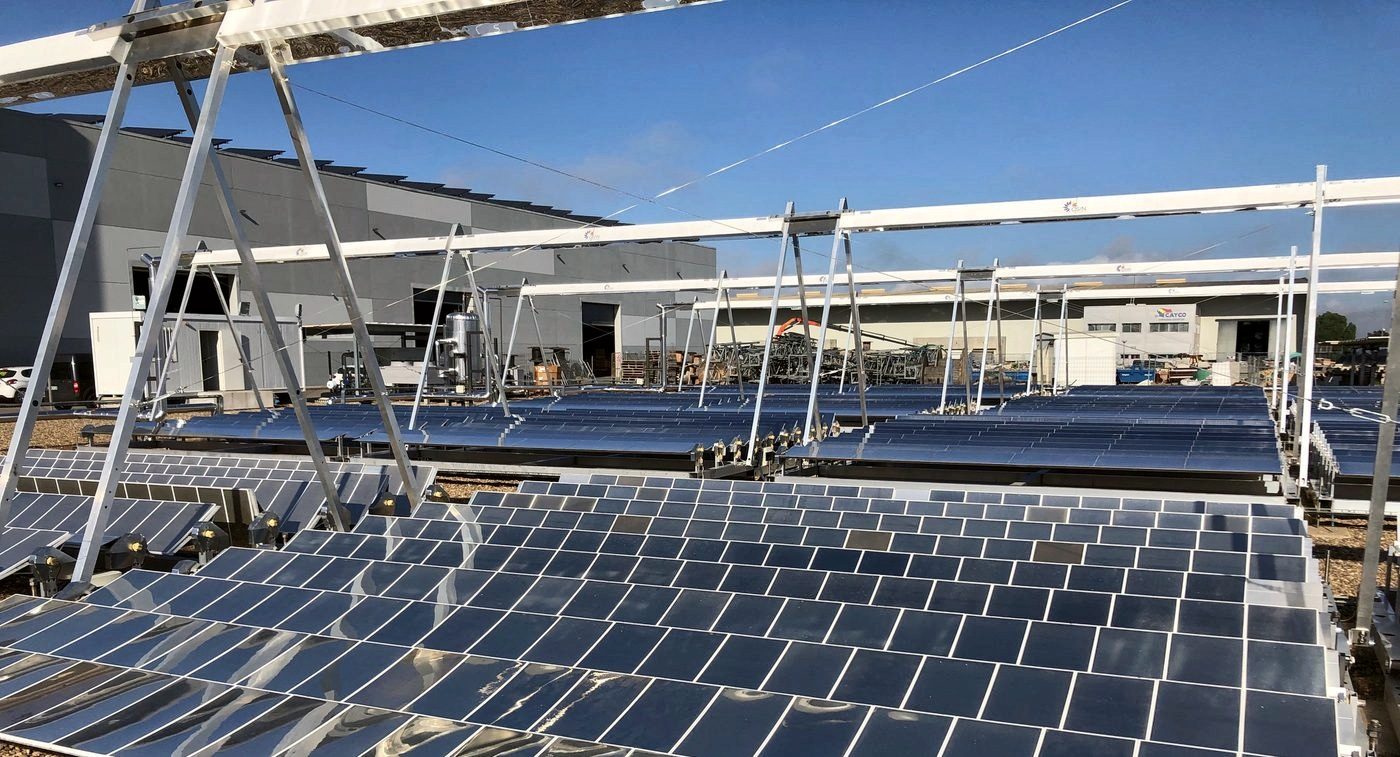
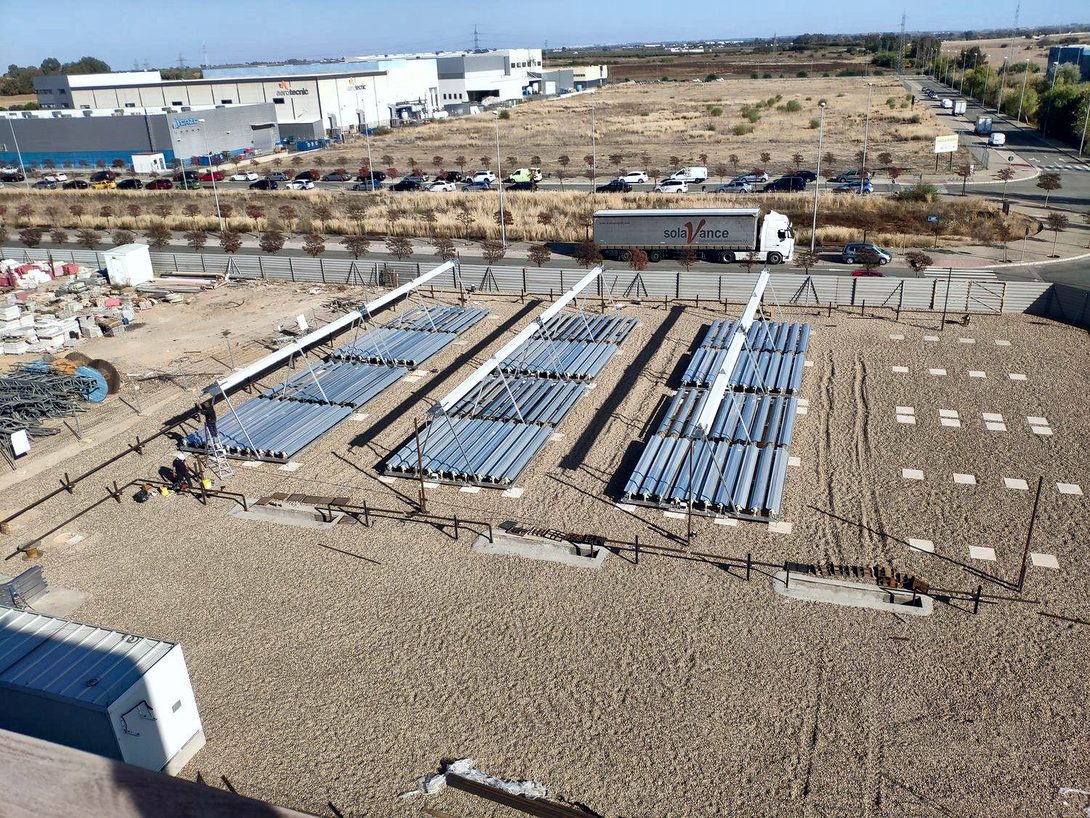
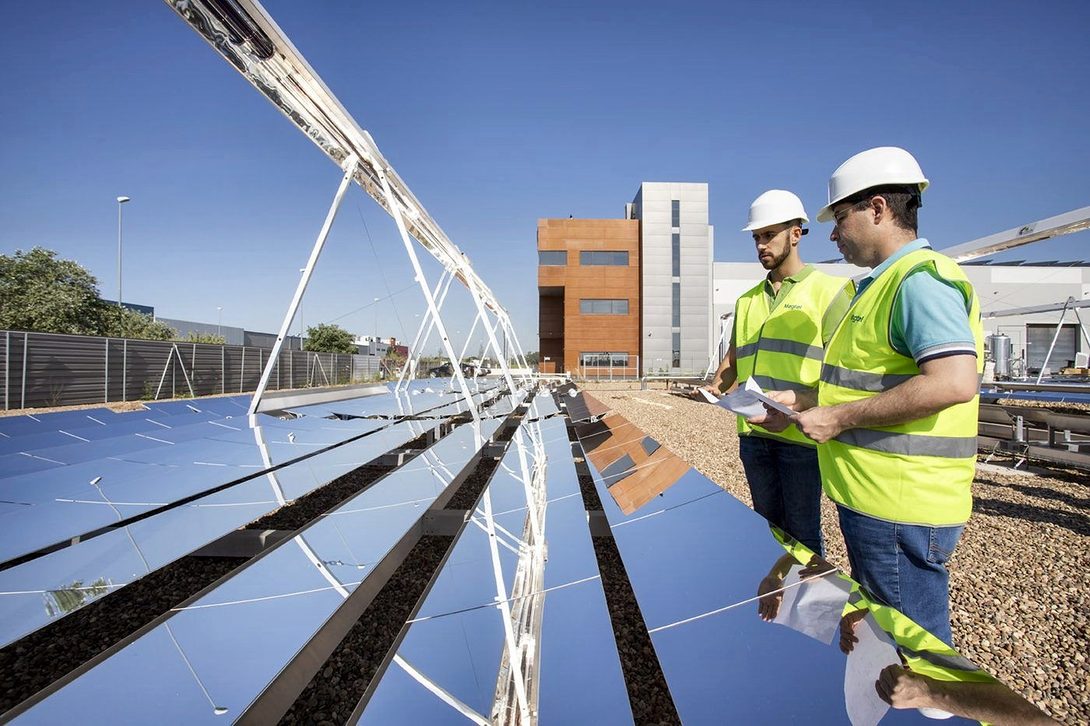
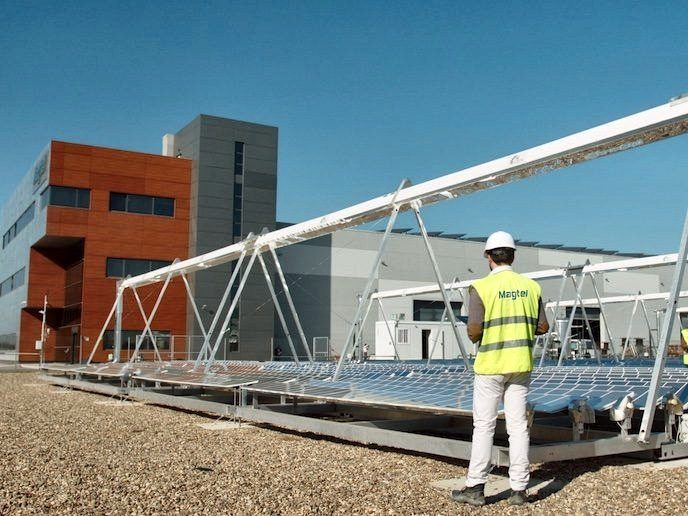
Rows of rectangular mirrors mounted on the metal structure of a Fresnel collector, under a blue sky
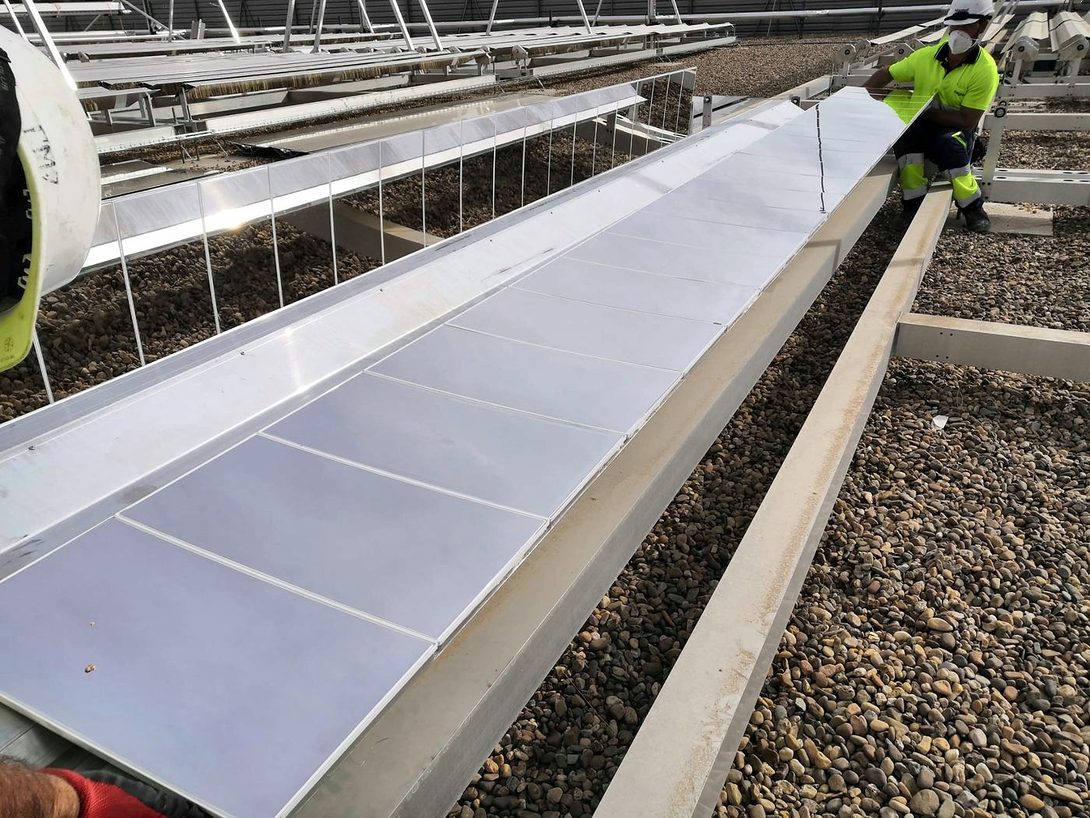
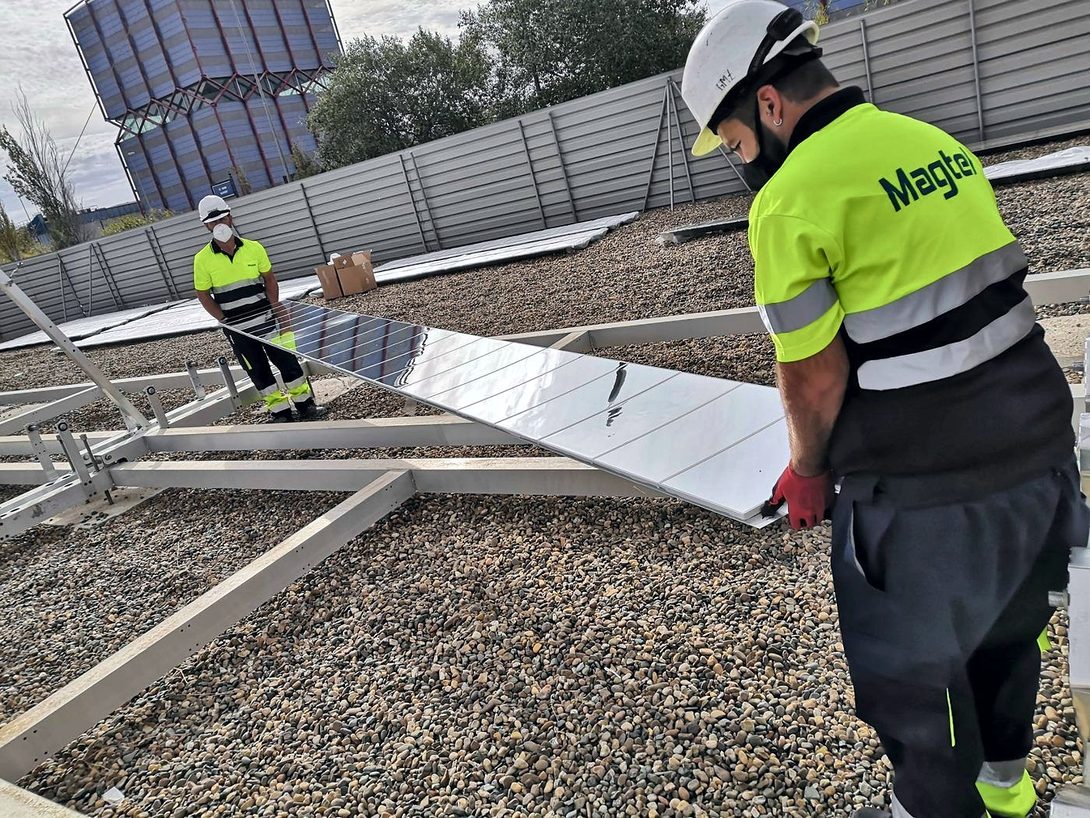
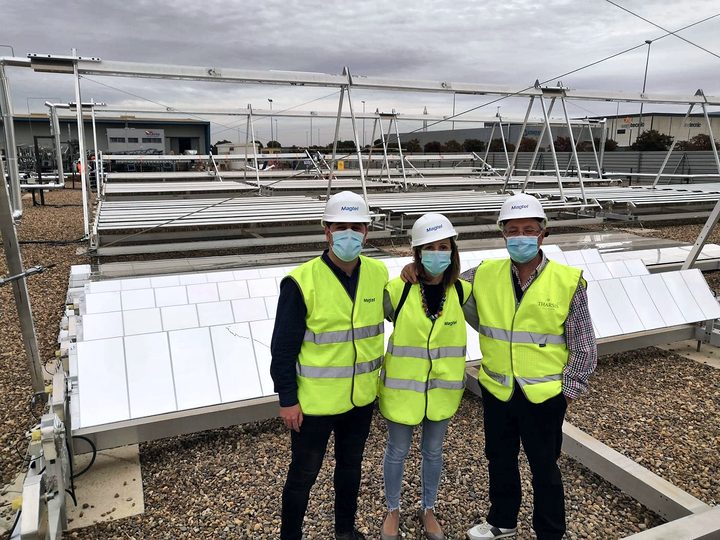
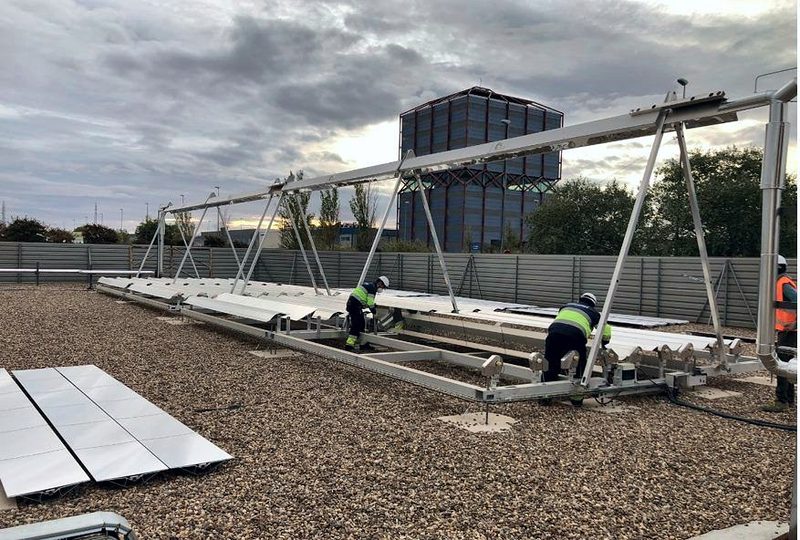
Our polymeric mirrors on the Fresnel collector of MAGTEL’s pilot plant in Seville (2020).
€5.82 Mbudget of IN-POWER, a European Horizon 2020 project with eleven partners, with €4.99 M of European funding
Leadersof two IN-POWER work packages, the mirror and the solar field, and of its intellectual property management
9030.50 × 0.25 m mirrors metallised in series, from some 1,000 injection-moulded parts
840mirrors installed, 105 m², in MAGTEL’s Fresnel pilot plant at Aerópolis (Seville)
+2,400laboratory measurements on 80 recipes and versions of the mirror
95.8 %specular reflectance at 660 nm in the best version of REFLEXIS, above the 95.3 % of the reference glass, measured at the Plataforma Solar de Almería
1 of 8projects chosen from 479 applications from around the world by the Fundación Repsol Entrepreneurs Fund in 2013
Key Innovatorfor the IN-POWER polymeric mirror in the European Commission’s EU Innovation Radar, with “Tech Ready” maturity

Nematia Thermosolar
2008-2021

Nematia Thermosolar

How a solar thermal power plant works

Unlike a photovoltaic panel, a solar thermal power plant uses mirrors to concentrate sunlight and produce heat, and with that heat, electricity. How much energy enters the plant depends on the mirrors.

Three main families of plants are built today. There are parabolic trough collectors, linear Fresnel collectors, with rows of almost flat mirrors close to the ground, and tower plants. In all of them, the solar field covers hectares of mirrors that have to be made, installed, aimed and cleaned often. There is a fourth, the parabolic dish with a Stirling engine, which has not caught on commercially.

Thousands of mirrors track the sun and reflect its radiation onto a receiver. That receiver is a tube in parabolic trough and Fresnel collectors, and in tower plants it sits at the very top. A fluid runs through it and heats up to several hundred degrees. That heat produces steam and drives a turbine, as in a conventional power plant. Because the heat can be stored in molten salt tanks, the plant keeps generating after sunset.

The usual mirror is glass several millimetres thick, silvered on the back. It reflects well, but it is heavy, it has to be curved and mounted on a separate structure, and wind, hail or handling can break it. Spain is one of the countries with the most installed solar thermal capacity in the world, and much of it is in Andalusia, so from Jaén we had the sector close at hand.

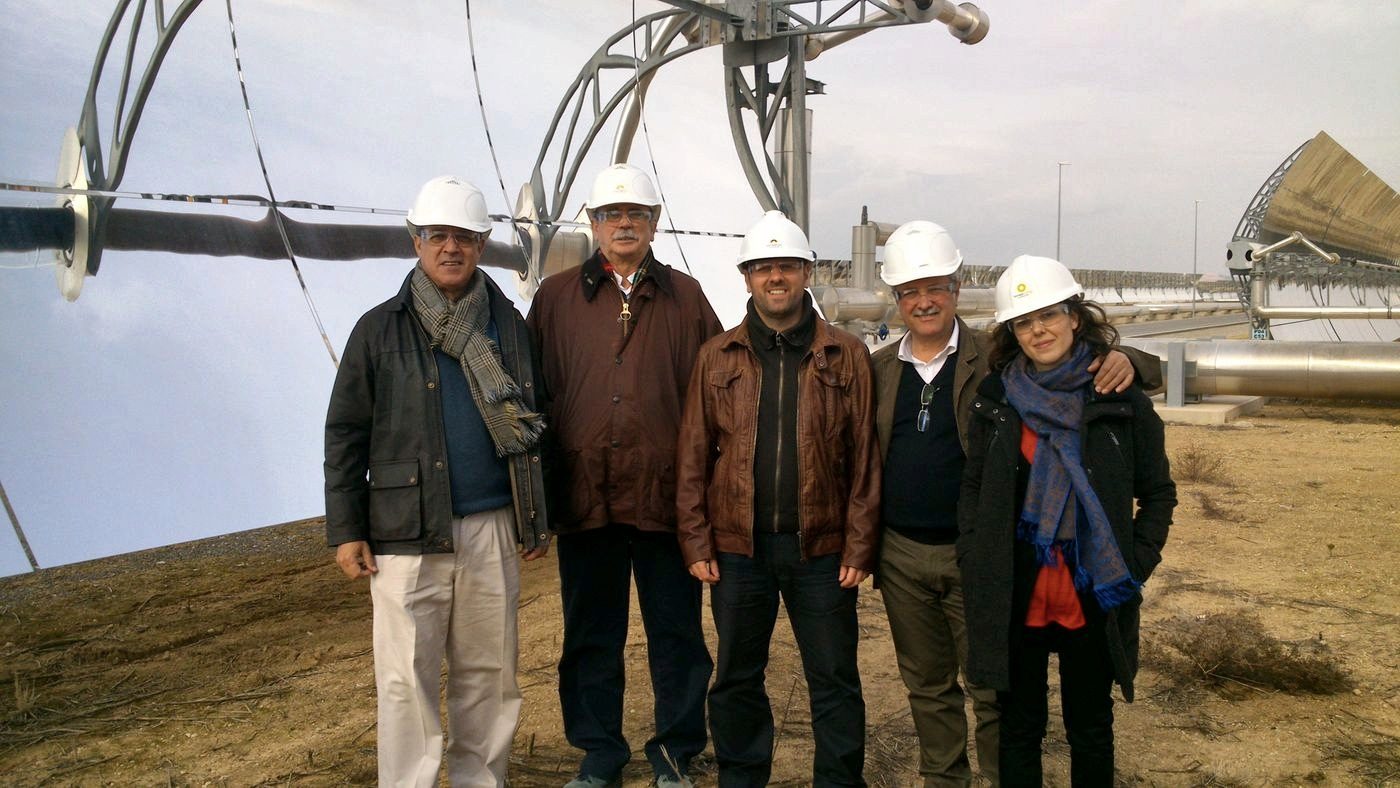
Six people in hard hats pose in front of the parabolic trough collectors of a solar thermal power plant
With the Entrepreneurs Fund mentors on a technical visit to the Valle 1 solar thermal plant (Cádiz). December 2013.
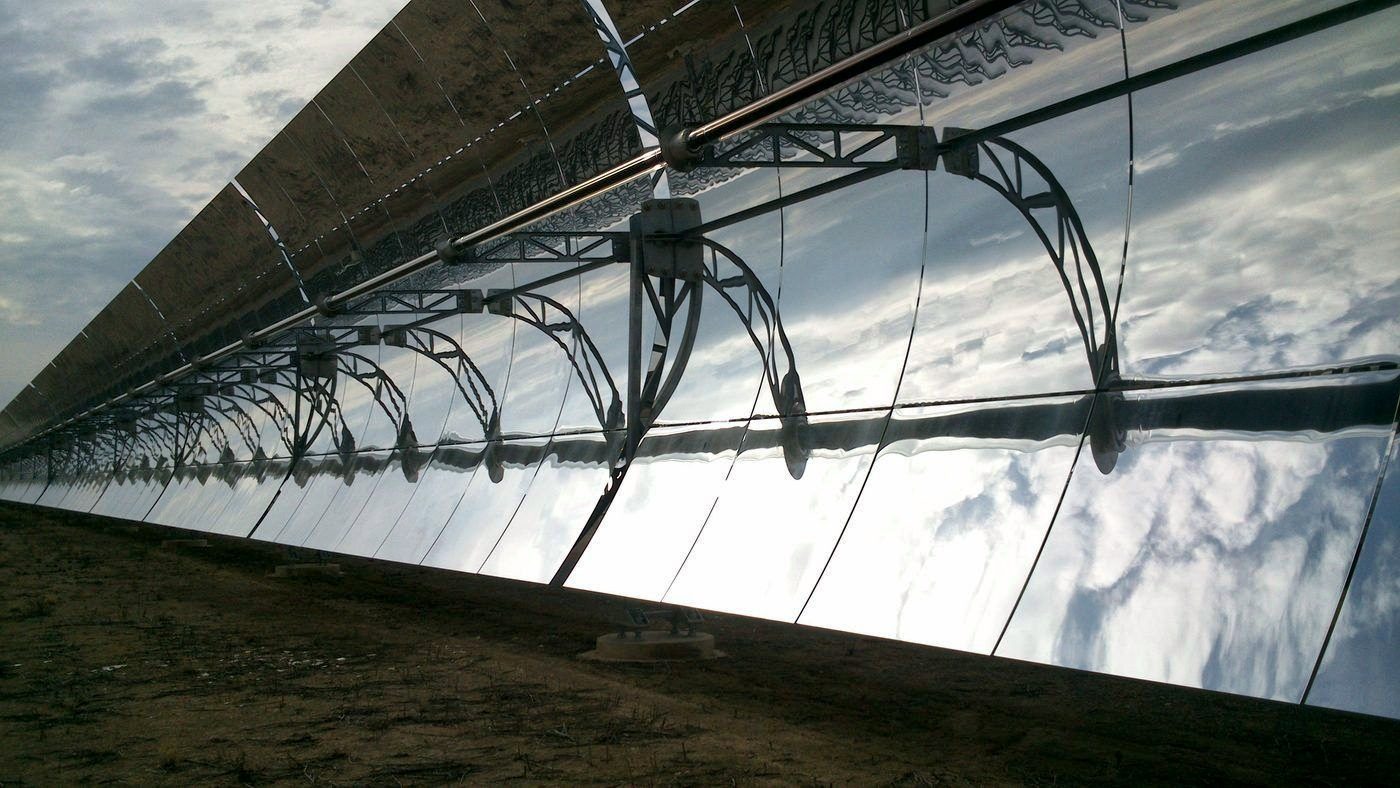
Row of parabolic trough collectors seen close up under a cloudy sky
The parabolic trough collectors of Valle 1, close up, on the same visit.

Linear Fresnel plant

Tracking on one axis · fixed linear receiver · molten salt at ≈550 °C in recent plants

Animated diagram of a linear Fresnel plant. The sun crosses the sky and a row of mirrors turns to reflect its light onto a raised receiver tube. Above the tube, a secondary mirror collects the light that does not reach it directly and sends it back. The molten salt heats up in the tube and goes down to the hot tank; from there it goes to the steam generator, which drives the turbine and generator connected to the power grid, and returns to the cold tank. At night the mirrors are stowed and the hot tank, whose level drops, keeps the turbine running. Sun Hot tank ≈550 °C Cold tank ≈290 °C Steam generator steam Turbine and generator Power grid Receiver secondary mirror Solar field mirrors track the sun and concentrate its light molten salt

By day, the receiver heats the molten salt and fills the hot tank.

Simplified diagram of a linear Fresnel plant, the type of pilot plant where our mirrors were installed. The first Fresnel plants produced steam directly in the tube, at about 270 °C and with almost no storage. The most recent ones heat molten salt to about 550 °C and store it in tanks. They do this with receivers built for high temperatures. Above the tube there is also a secondary mirror, which collects the light that does not reach it directly and sends it back to it.
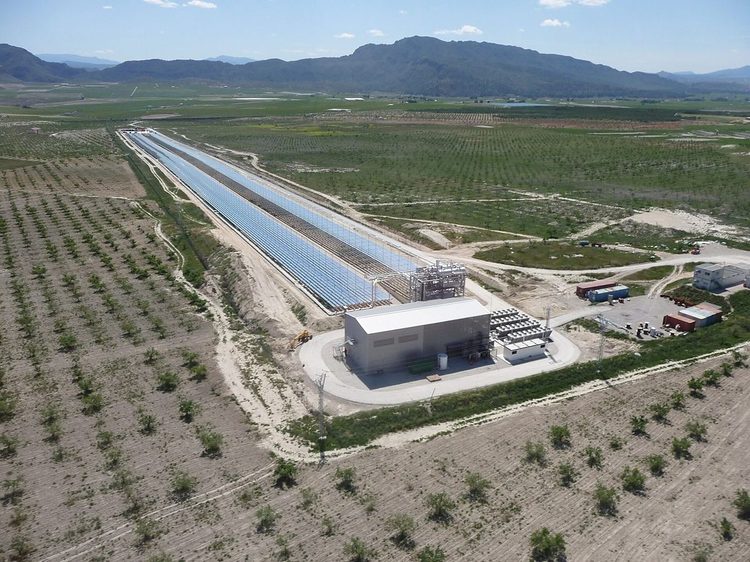
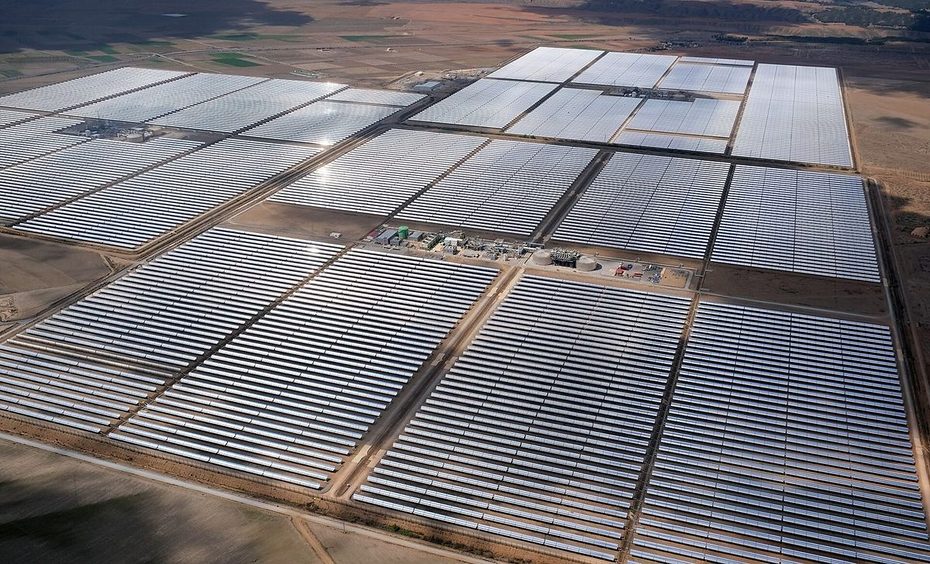
Aerial view of a Fresnel plant: a long row of flat mirrors under its raised receiver, next to the turbine building
Puerto Errado 1, a Fresnel plant that makes its steam directly in the receiver. You can see the rows of almost flat mirrors and, above them, the raised receiver.
Location
Calasparra (Murcia, Spain)
Capacity
1.4 MW
In service
since 2009
Fluid
water and steam
Photo: Novatec Biosol / Wikimedia Commons, Free Art License.

Parabolic trough plant

Tracking on one axis · linear receiver that turns with the trough · oil at ≈390 °C

Animated diagram of a parabolic trough plant. Rows of parabolic troughs turn on their axis to track the sun and concentrate its light on the absorber tube at their focus. Thermal oil at about 390 °C flows through the field to the steam generator; the steam drives the turbine and generator connected to the power grid. By day, part of the hot oil passes through an oil/salt heat exchanger and fills the hot molten salt tank; at night the salt gives the heat back to the oil and the turbine keeps running. Sun absorber tube Parabolic troughs turn on their axis to track the sun thermal oil ≈390 °C Steam generator steam Turbine and generator Power grid Oil/salt heat exchanger Cold tank Hot tank

By day, the hot oil makes steam and charges the salt through the heat exchanger.

Simplified diagram of a parabolic trough plant. Each trough turns on an axis to track the sun and concentrates the light on the absorber tube at its focus. Thermal oil flows through the field; the heat is stored in two molten salt tanks through a heat exchanger.
Aerial view of long parallel rows of parabolic trough collectors on a plain
Andasol, a group of three parabolic trough plants that heat oil in the solar field and store the heat in salt tanks to keep generating at night.
Location
Aldeire and La Calahorra (Granada, Spain)
Capacity
3 × 50 MW
In service
since 2008
Storage
7.5 h in molten salt
Photo: kallerna / Wikimedia Commons, CC BY-SA 4.0.

Molten salt tower plant

Tracking on two axes · point receiver at the top of the tower · molten salt at ≈565 °C

Animated diagram of a molten salt tower plant. A field of heliostats tracks the sun and reflects its light onto the receiver at the top of the tower. The cold salt, at about 290 °C, rises from its tank, heats up in the receiver to about 565 °C and comes down to the hot tank. From there it goes to the steam generator, which drives the turbine and generator connected to the grid, and returns to the cold tank. At night the heliostats are stowed and the hot tank, whose level drops, keeps the turbine running. Each heliostat turns on two axes. Sun Receiver Heliostat field reflect the sun onto the receiver Hot tank ≈565 °C Cold tank ≈290 °C Steam generator steam Turbine and generator Power grid

By day, the salt heats up in the receiver and fills the hot tank.

Simplified diagram of a molten salt tower plant. The heliostats reflect the sun onto the receiver. The salt goes up to the receiver at about 290 °C, comes back at about 565 °C and waits in the hot tank until steam is needed, by day or by night. Each heliostat turns on two axes to track the sun.
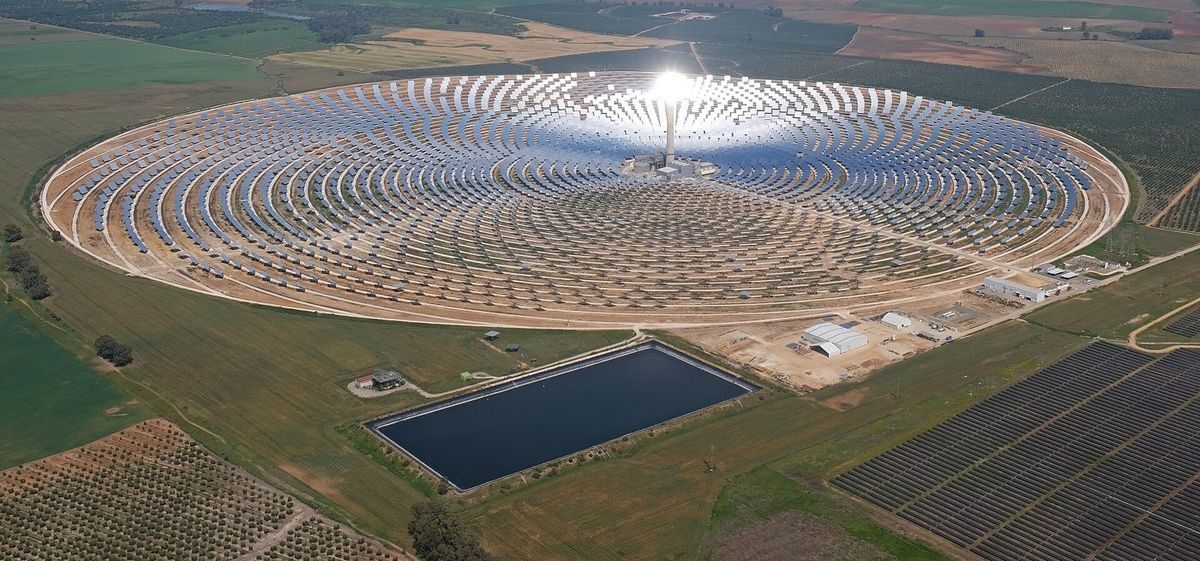
Aerial view of a circular field of heliostats concentrating light on a central tower, among farmland
Gemasolar was the first utility-scale plant to combine a tower with molten salt storage. Its circular field of heliostats surrounds the tower.
Location
Fuentes de Andalucía (Seville, Spain)
Capacity
19.9 MW
In service
since 2011
Storage
15 h in molten salt
Photo: kallerna / Wikimedia Commons, CC BY-SA 4.0.

Stirling dish

Tracking on two axes · point receiver at the focus · Stirling engine, no storage

Animated diagram of a parabolic dish with a Stirling engine. The dish, on a pedestal, tracks the sun and concentrates its light on the receiver at its focus. An inset enlarges the engine: the receiver heats one side of the cylinder, the other side is cooled by fins, and two pistons moving out of phase turn the flywheel of a generator connected to the power grid. At night the dish is stowed face down, the engine stops and no electricity is produced, because there is no storage. Sun Parabolic dish tracks the sun on two axes Stirling engine receiver hot side cold side generator Power grid

By day, the dish tracks the sun and the engine drives the generator.

Simplified diagram of a parabolic dish with a Stirling engine. The dish tracks the sun on two axes and concentrates the light on the receiver at its focus, which heats the engine’s working gas; the engine drives a generator. It holds the efficiency record in solar thermal power, 31.25 % of sunlight converted into electricity in 2008, but it does not store heat, so it stops at night. Today it is researched mainly for small or off-grid installations.
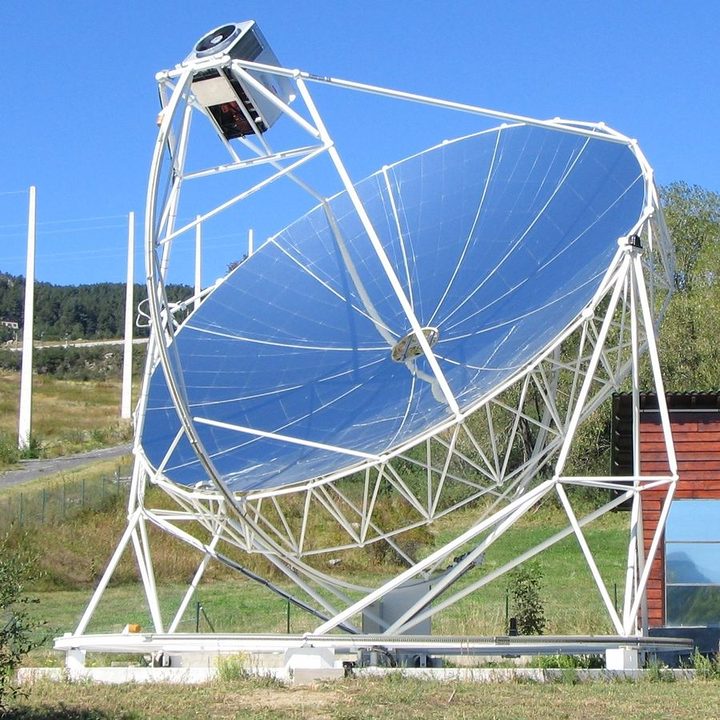
Parabolic mirror dish on a white steel structure, with the Stirling engine at its focus
Stirling dish from a research project. The engine and generator sit at the focus of the dish, which tracks the sun on two axes.
Location
Font-Romeu-Odeillo (France)
Year
2005
Tracking
two axes
Storage
none
Photo: Björn Appel / Wikimedia Commons, CC BY-SA 3.0.

Our own technology
Entrepreneurs Fund
2008-2021

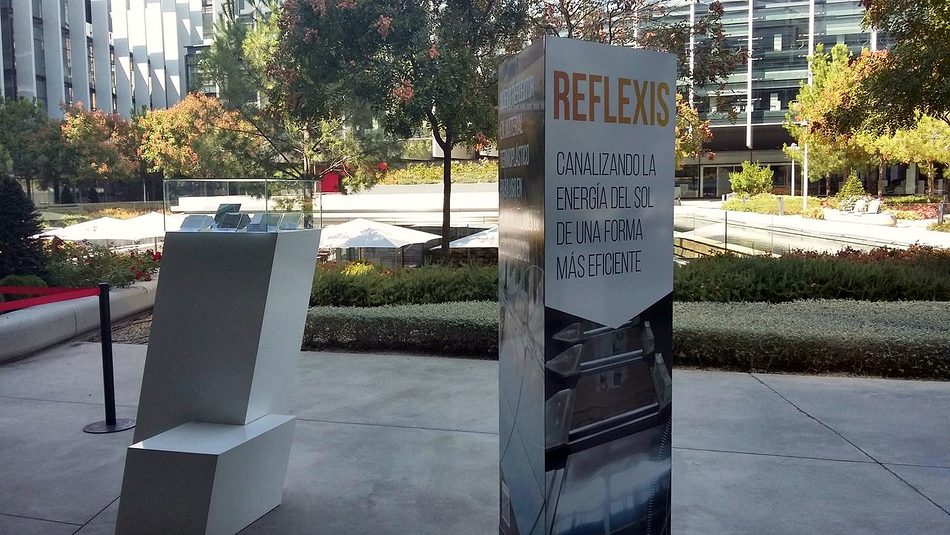
REFLEXIS

The solar mirror that comes out of the mould

The idea came from our experience with car headlamps, whose exact shape is injection-moulded in plastic, vacuum-metallised and protected in the same industrial sequence. We filed the patent in 2009 and developed it until 2021, from the sample to the pilot plant.

REFLEXIS is a first-surface silver mirror on injection-moulded polycarbonate. The part comes out of the mould with its optical curvature, its stiffening ribs and its fixing points. It is then silvered on the front face, so the light is reflected without passing through any glass, and protected with a transparent overmoulded coating that also covers the edge.

We chose that coating because it is made of a self-healing material. Under operating conditions, the micro-scratches left by sand and cleaning brushes close by themselves with the help of heat, and the surface does not turn matte, so the mirror does not lose efficiency. Together with a substrate that does not break, the mirror is designed to last in the solar field.

It is a light, glass-free reflector that allows geometries curved glass cannot achieve, and it is made with automotive mass-production processes.

  1. Substrate injectionPolycarbonate, injection-moulded or injection-compression moulded, with the optical shape, ribs and fixings built in.
  2. Vacuum metallisationFirst-surface silver deposited on the working face.
  3. Overmoulded self-healing coatingA transparent layer protects the silver, seals the edge of the part and repairs surface scratches by itself.

From the Entrepreneurs Fund to the first prototypes

Incubated by Fundación Repsol · 2013-2015

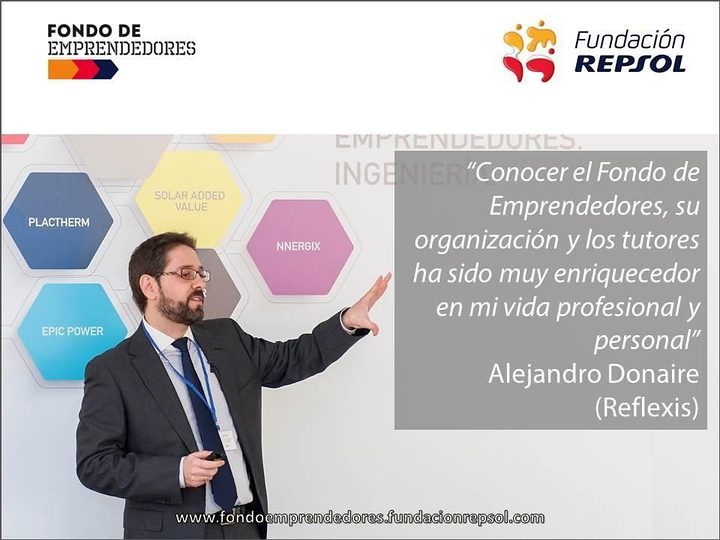
Entrepreneurs FundFundación Repsol

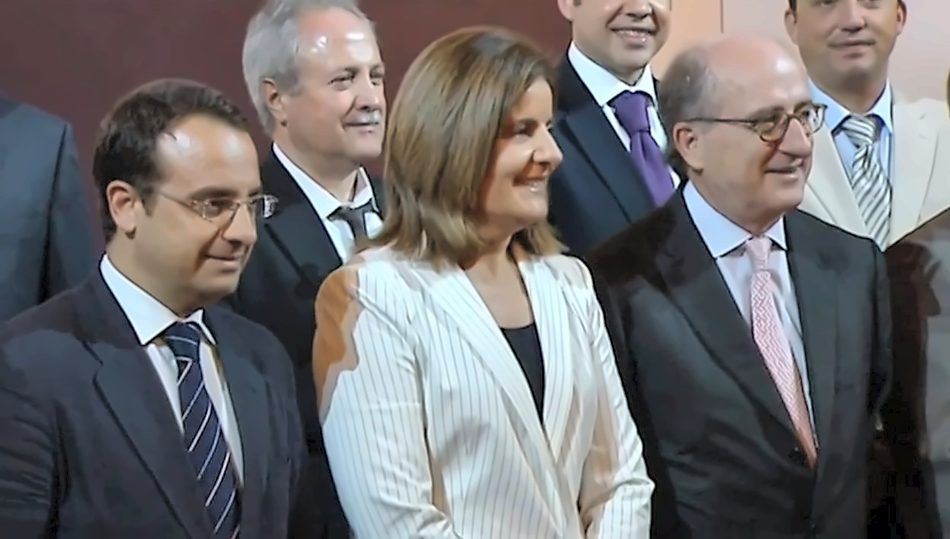
In July 2013, Fundación Repsol chose REFLEXIS from 479 applications from around the world for the second call of its Entrepreneurs Fund. We were the only Andalusian company selected.

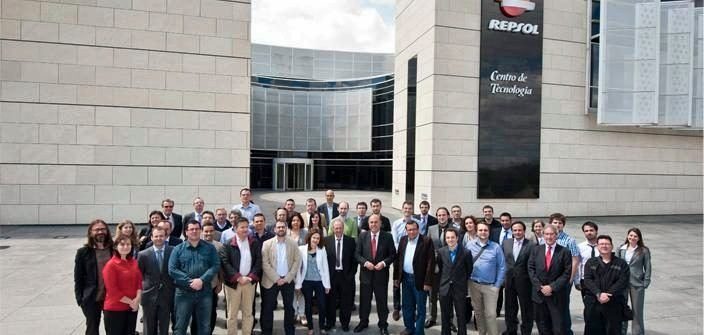
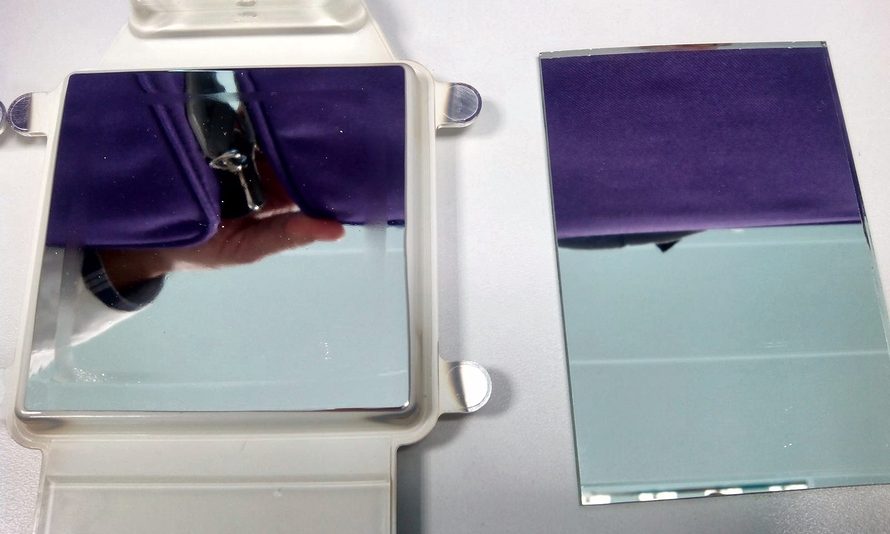
The incubation took place in two places. At the Repsol Technology Centre, in Móstoles, we used its facilities and received training and mentoring from its experts. In Martos, in December 2013, we moved into an office in the building of Andaltec, the Plastics Technology Centre. The Fund also provided financial support. In those two years we went from the idea to the first injection-moulded prototypes, passed the accelerated CASS corrosion test at the Plataforma Solar de Almería and reached sample “Z”, a 10 × 10 cm sample with the best version of the mirror.

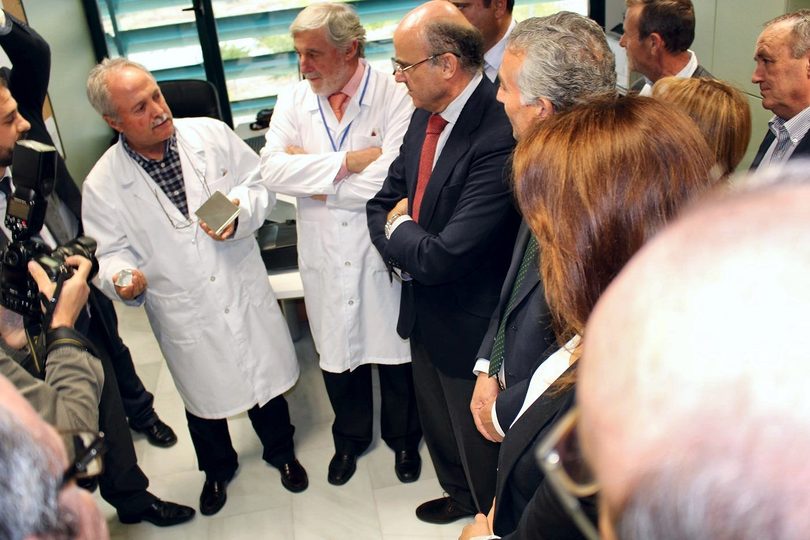
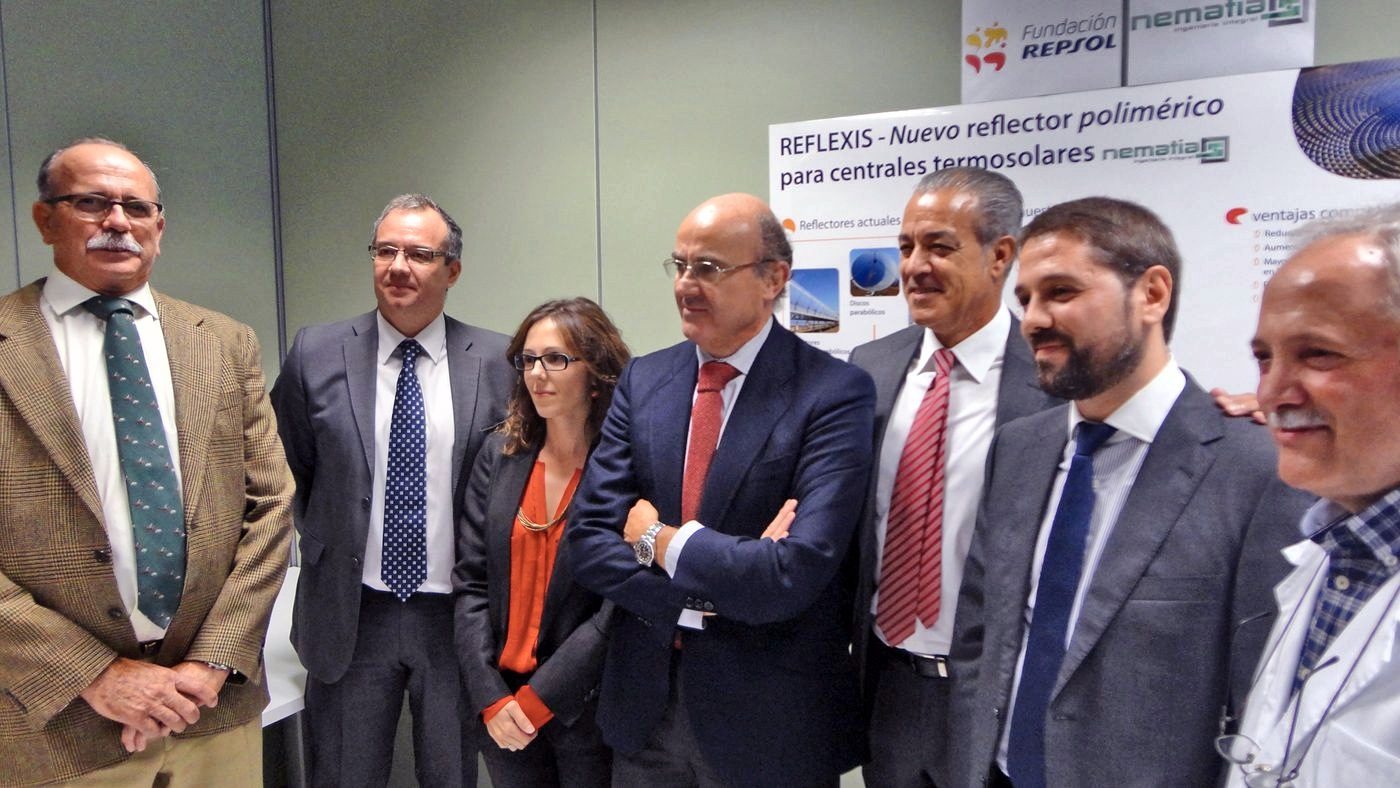
The Fund brought investment forums, meetings with companies and institutional visits, including one by the Minister of Economy, Luis de Guindos, to our office in November 2014. With that groundwork we joined the European project IN-POWER.

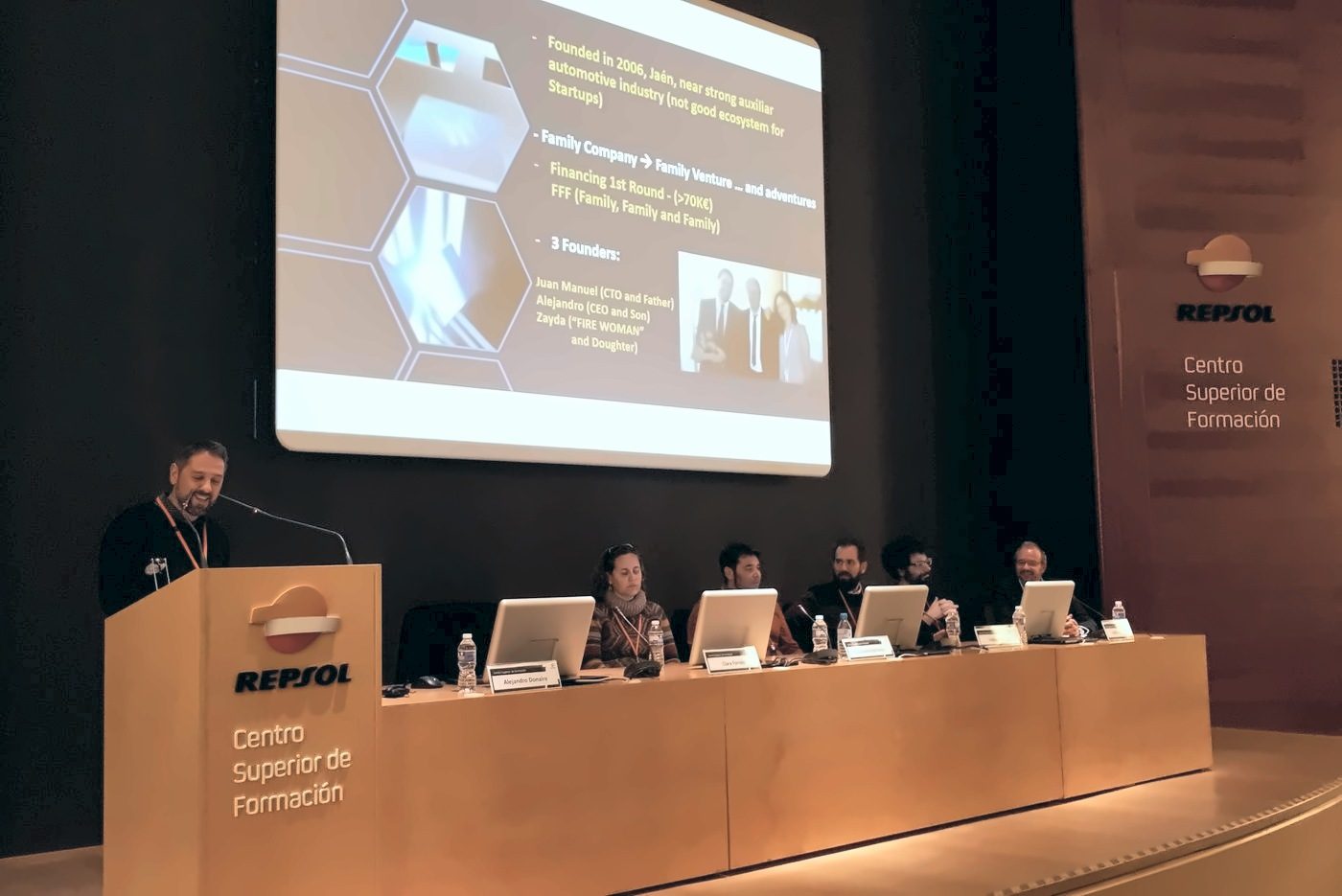
In April 2018, Fundación Repsol invited us to give a talk at the Repsol Technology Centre, in Móstoles, as part of a selection of the Fund’s success stories. We told the story of our ten years of R&D, from the patent to the European consortium.


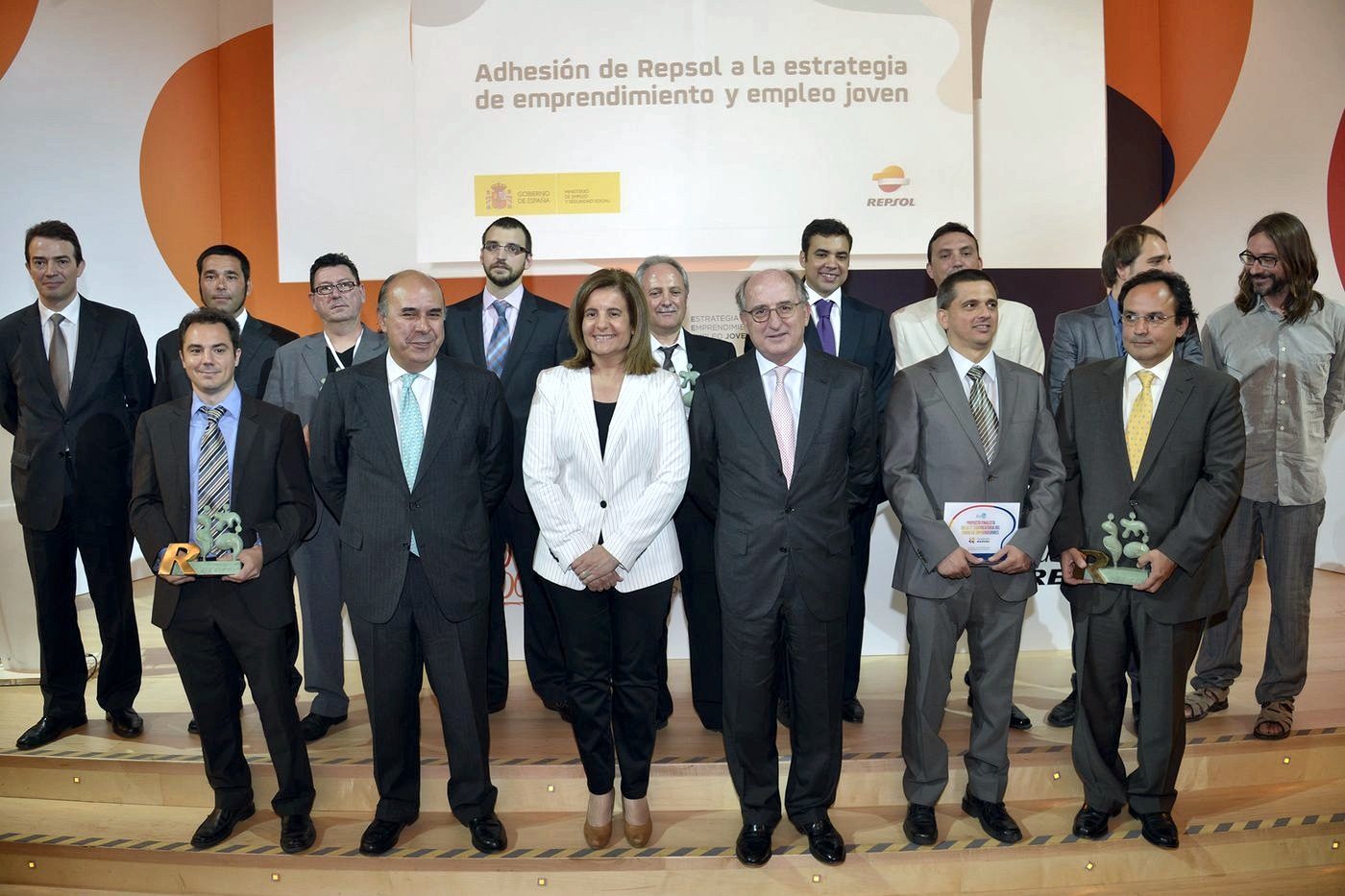
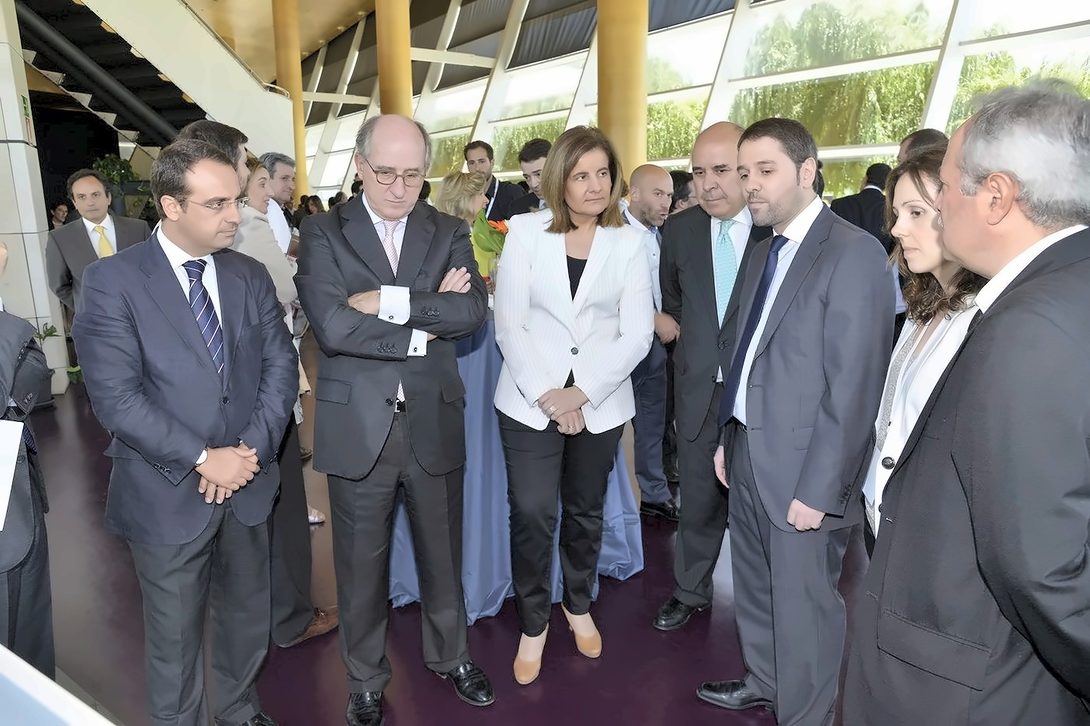
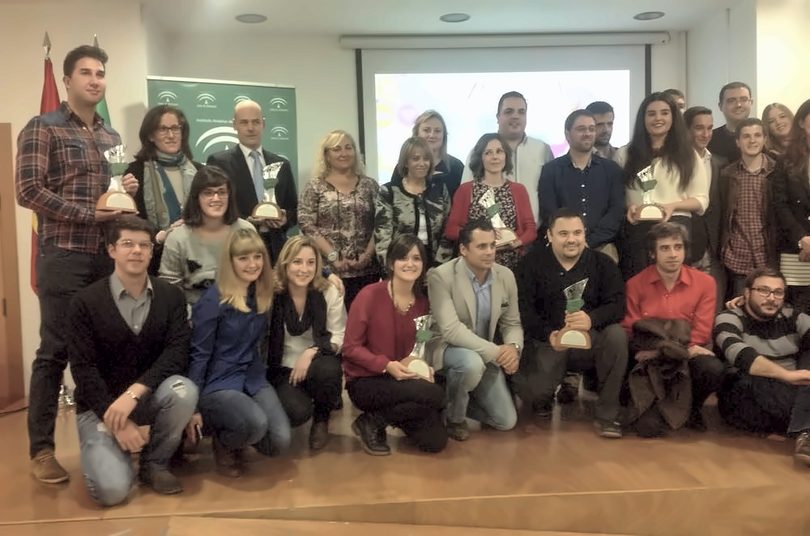
The selected entrepreneurs pose with their trophies alongside officials at the Fundación Repsol event
Entrepreneurs Fund selection event. July 2013.
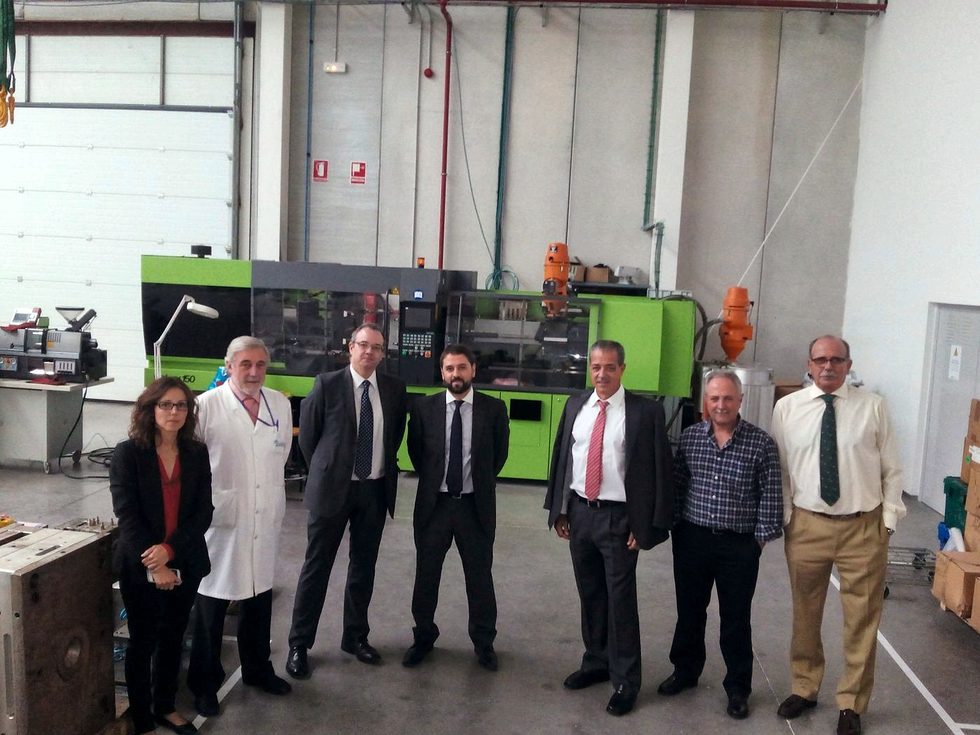
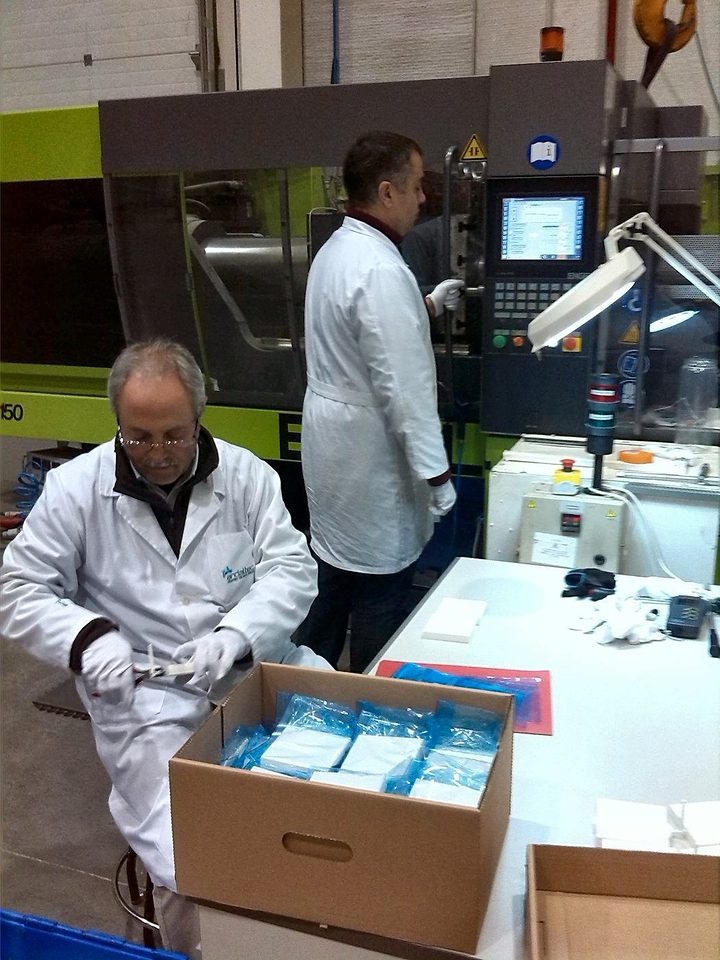
Group of people in an industrial building with injection moulding machines, two of them in white coats
The Fund’s mentors visiting Andaltec.
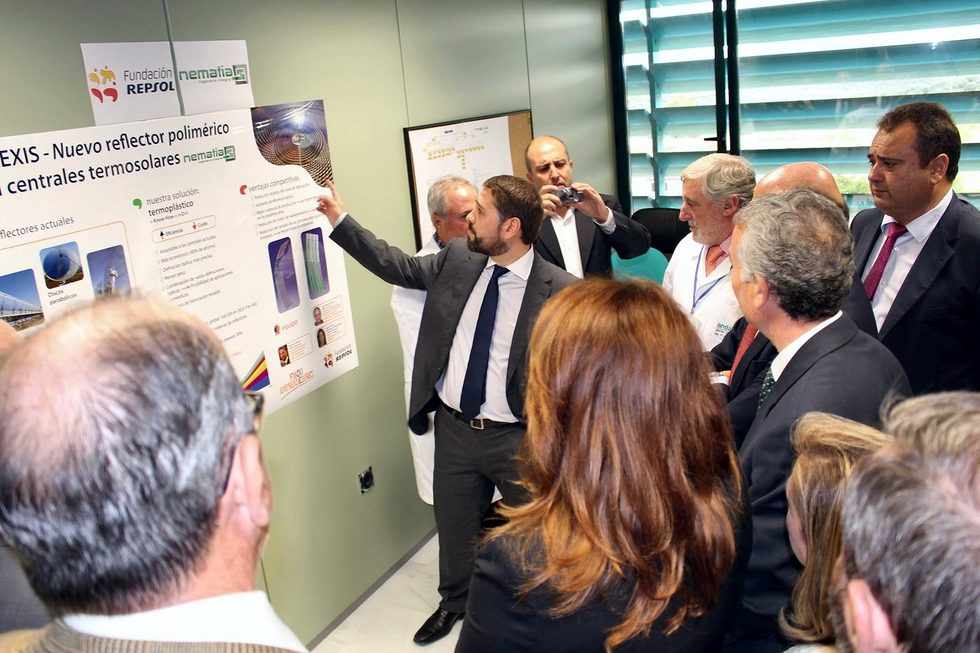
A team member points to the REFLEXIS panel in front of the minister’s delegation
We present REFLEXIS to Minister Luis de Guindos at our office in Andaltec. November 2014.

The Entrepreneurs Fund in pictures

Advantages over the glass mirror

Click each row or tab to see its animated diagram.

Glass mirrorREFLEXIS
ReflectionSecond surface, light crosses the glass twiceFirst-surface mirror, reflects without crossing glass
HailFragile against hail and knocksUnbreakable in operating conditions
AbrasionScratches stay and the surface goes mattSelf-healing coating that closes micro-scratches
MountingBent and mounted in several partsLeaves the mould with ribs and fixings
ShapeWhatever bending the sheet allowsWhatever shape a mould allows
Weight4 mm glass on a structureLighter and stiffer thanks to its ribs
ProcessIf damaged, replaced wholeSeries processes and a reusable substrate
Reflection. The glass mirror is a second-surface mirror: light bends as it enters and leaves the glass, and the reflected ray comes out offset from the ideal one. REFLEXIS is a first-surface mirror that reflects off the silver on the front face without crossing any glass Glass mirrorREFLEXISoffsetsecond surfacesilver (back)light is offsetfirst surfacesilver at frontno offset

Not to scale. The glass mirror is a second-surface mirror. Light crosses the glass on the way in and out to the silver at the back, and bends slightly as it enters and leaves, so the reflected ray comes out offset from the ideal one (dashed line). REFLEXIS is a first-surface mirror that reflects off the silver on the front face, under a transparent coating, without passing through any glass.

Hail: a hailstone with sharp edges falls on both mirrors. The glass mirror cracks and splits; REFLEXIS flexes slightly and stays intact Glass mirrorREFLEXIShailhailglasscracksand splitspolycarbonateflexes slightlyand stays intact

Not to scale. Hailstones have sharp edges and strike like stones. Glass is fragile against hail, wind and handling. The REFLEXIS polycarbonate absorbs the impact, and in the 2014 and 2015 tests by ISFOC and Andaltec it withstood 25 mm hail without damage.

Abrasion, enlarged detail. Sand and the cleaning brush scratch the surface of both mirrors. On glass the scratches stay and light scatters; on REFLEXIS the self-healing coating closes the scratches with heat, the surface does not go matt and the mirror keeps its efficiency Glass mirrorREFLEXISglassscratches staylight scattersself-healingcoatingdoes not go matt

Enlarged detail, not to scale. Wind-blown sand and cleaning brushes scratch the surface. On glass the scratches stay, the surface goes matt and scatters light. On REFLEXIS the self-healing coating closes the micro-scratches and the surface does not go matt.

Mounting. The glass mirror is bent and mounted with brackets on a separate structure. REFLEXIS leaves the mould in one piece, with its curvature, ribs and fixing points inside its own envelope, nothing sticking out, and sits on simple supports that do not come out of the mould Glass mirrorREFLEXISseveral partsglass, supportsand structureout of the mouldwith ribsand fixing points

Not to scale. A glass mirror is bent and mounted with brackets on a separate structure. REFLEXIS comes out of the mould in one piece, with its curvature, stiffening ribs and fixing points built into its own envelope, with nothing sticking out. The supports do not come out of the mould, but they are simpler and there is less to assemble.

Shape: glass bends into simple shapes, and a complex shape such as a ribbed dish is not possible; REFLEXIS takes the shape of the mould: a trough, a ribbed dish or a faceted panel Glass mirrorREFLEXISglasssimple curvesonlyany shapea mouldcan make

Not to scale. Glass is bent from a flat sheet, and its shape depends on that bending. REFLEXIS admits geometries that bent glass does not, because it takes whatever shape the mould has, whether double-curved, faceted or ribbed, in a single piece.

Weight: on a balance, the 4 mm glass mirror weighs more than the REFLEXIS part, which is lighter and stiff thanks to its ribs Glass mirrorREFLEXIS4 mm glassheavierneeds a structurelighterstiff thanksto its ribs

Not to scale. For the same area, REFLEXIS weighs less than a 4 mm glass mirror, and its stiffness is built into the part through moulded ribs. Glass relies on a structure to give it that stiffness.

Process. A damaged glass mirror is removed and replaced with a new one. REFLEXIS is made by injection, metallising and protection; at the end of its life the outer layer is stripped, the part is metallised and protected again, and the mirror goes back to work without another injection Glass mirrorREFLEXIS123Sdamaged mirroris replacedby a new one1 injection2 metallising3 protectionS stripping

Not to scale. First manufacture goes through substrate injection (1), metallising (2) and protection by overmoulding (3), series processes from the automotive sector. At the end of its life the substrate is not thrown away. The outer layer is stripped (S), the part is metallised and protected again, and the mirror goes back to work without another injection (dashed arrow). A damaged glass mirror is replaced as a whole.

Laboratory results, from REFLEXIS to IN-POWER

95.8%

Specular reflectance (the light the mirror reflects in the right direction, within a very small angle) of sample “Z”, the best of the 80 recipes and versions we tested. It beats the reference glass mirror, which gave 95.3 %, by half a point.

ρs · 660 nm · 12.5 mrad · Plataforma Solar de Almería (CIEMAT) · Dec 2015

120h

In copper-accelerated acetic acid salt spray (CASS) with no measurable loss of reflectance and no visible edge corrosion, with the edge sealing of the third prototype phase.

ISO 9227 · Plataforma Solar de Almería · Nov 2015

480h

In neutral salt spray without pitting, with the perimeter sealing channel of the IN-POWER mirror.

NSS · ISO 9227 · IN-POWER · 2019-2020

25mm

Hail with no damage to the mirror. The polycarbonate absorbs an impact that would break a glass mirror.

Hail impact · ISFOC and Andaltec · 2014 and 2015

1.1%

Change in reflectance after abrasive washing equivalent to a year of cleaning.

Abrasive washing · IN-POWER · 2019-2020

6 + 3months

Six months outdoors in Terrassa (Spain) and three in Ovalle (Chile), on the southern edge of the Atacama Desert, in very harsh conditions. The coated samples kept their reflectance.

Outdoor exposure · LEITAT · 2020-2021

Applications

  • Solar thermal power plants: linear Fresnel collectors, parabolic troughs and heliostats.
  • Solar heat for industrial processes, with compact collectors.
  • Technical reflectors and lighting.
  • Lightweight optics for telescopes and for space, with the same principle and other materials.

Industrial property

We protected the invention with Spanish patent ES2360777, “Reflector solar y procedimiento de fabricación”, filed in 2009 and granted in 2012, and with its international PCT extension (WO2010086468). It has been cited by later applications, including one by CIEMAT.

European project
2017-2021

IN-POWER Funded by the European Union’s Horizon 2020 programme

A glass-free mirror for European solar thermal power

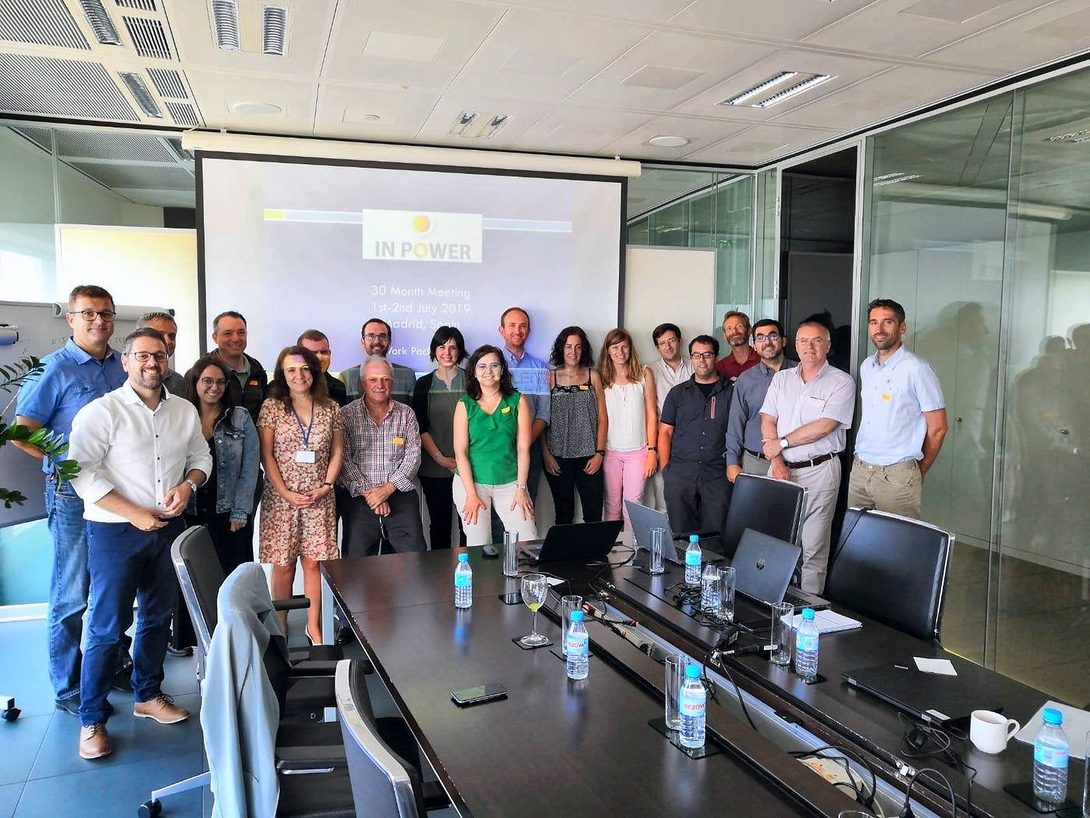
After the incubation in the Entrepreneurs Fund, between 2017 and 2021 we were part of IN-POWER, a consortium of eleven partners from Spain, Germany, Italy and France coordinated by the technology centre LEITAT. The project aimed to make solar thermal electricity cheaper with advanced materials, and our task was to design the new mirror and take it to industrial scale.

Its full name was Advanced Materials technologies to QUADRUPLE the Concentrated Solar Thermal current POWER GENERATION. It had a budget of €5.82 M, of which the European Union contributed €4.99 M, and it set out to renew almost every component of a solar thermal power plant:

  • glass-free, high-reflectance, self-healing and anti-soiling mirrors;
  • lighter support structures and a solar field that takes up much less land;
  • absorber tubes with new coatings that do not need a vacuum;
  • higher-capacity thermal storage;
  • and their demonstration in two pilot plants, a Fresnel collector in Seville and a parabolic trough in Casaccia (Italy).

We shared the consortium with technology centres and research institutes such as LEITAT, Tekniker, France’s CEA and Italy’s ENEA, and with companies such as Fertiberia and MAGTEL. As a microenterprise from Jaén, we received €394,119 of European funding, led two of the technical work packages and managed the intellectual property of the whole consortium.
Rows of installed mirrors under the Fresnel collector structure, with industrial buildings and blue sky in the background
Our mirrors, installed in the Fresnel collector of MAGTEL’s pilot plant. December 2020.

Our role

  • Leaders of work package 3 (WP3), the polymeric mirrorBuilding on REFLEXIS, we designed and developed a lightweight, multilayer polymeric mirror with high optical and mechanical performance, together with its moulds, its tooling and the new materials of its structure. We coordinated the manufacturing chain with Kolzer (Italy), Votteler (Germany) and Geocad (Spain).
  • Leaders of work package 6 (WP6), the solar field designWe worked on a solar field architecture that improves on the design of current plants and takes up less land for the same output, and on its modelling.
  • Consortium IPR managerWe led the management and protection of the intellectual property of IN-POWER, and Alejandro Donaire was IPR manager for the eleven partners throughout the project. Among other tasks, his job was to review the technical results systematically to identify which could be patented or protected in other ways, working with the partners who developed them.
  • Exploitation committeeWe sat on the IN-POWER exploitation committee, chaired by LEITAT, where Alejandro Donaire represented us. The committee assessed the market potential of the project’s results and proposed how to exploit them. For the polymeric mirror, we led the exploitation team with Kolzer, Votteler and Geocad.
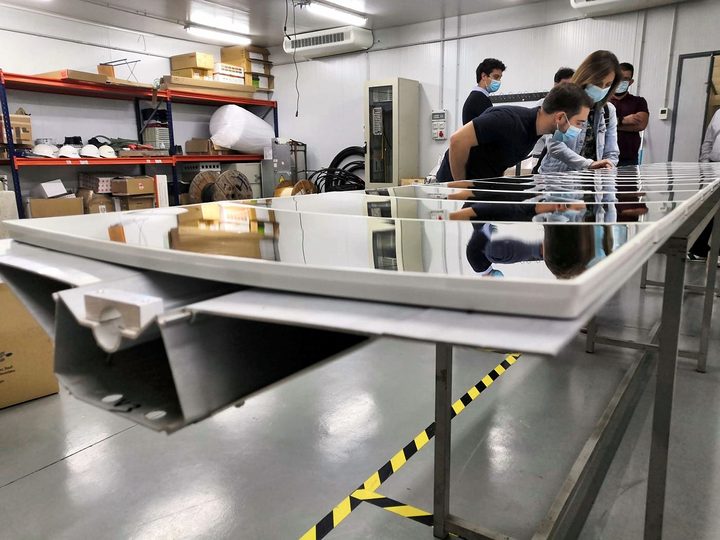
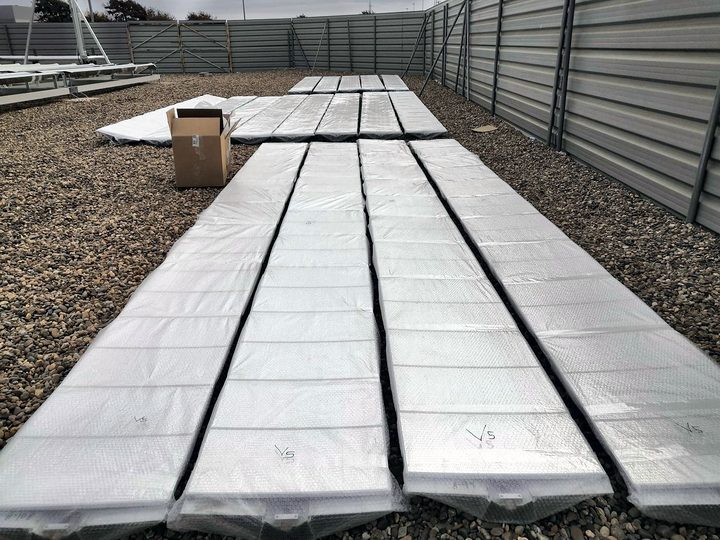
  • Scale-up and pilot plantWe went from the 10 × 10 cm sample to a 0.50 × 0.25 m part made by injection-compression moulding. We metallised 903 mirrors, and 840 of them (105 m²) were installed in MAGTEL’s Fresnel pilot plant at Aerópolis (Seville).
  • Hosts and disseminationWe hosted the consortium’s six-month meeting in Jaén, co-authored the project poster at SolarPACES 2018 and took part in the project’s public report on standardisation.

From the sample to the IN-POWER part

Diagram of the mirror: plan view of the 500 by 250 millimetre part and section A–A not to scale, with the curved polycarbonate substrate and two ribs, the silver on the front face and the transparent coating that wraps around the edge PLAN VIEW · DIMENSIONS IN MM A A 500 250 1 2 3 SECTION A–A · NOT TO SCALE
Diagram of the mirror. Top, the IN-POWER part in plan view, with dimensions in millimetres. Bottom, section A–A, not to scale: 1, injection-moulded polycarbonate substrate, with its curvature, ribs and fixings; 2, first-surface silver; 3, transparent overmoulded coating, which also covers the edge.
The 10 by 10 centimetre sample and the 50 by 25 centimetre part drawn to the same scale sample 10 × 10 cm IN-POWER part 0.50 × 0.25 m
The 10 × 10 cm sample of the first prototypes and the 0.50 × 0.25 m IN-POWER part, drawn to the same scale. The dashed line marks the size of the sample on the part.

Project timeline

  1. JAN 2017

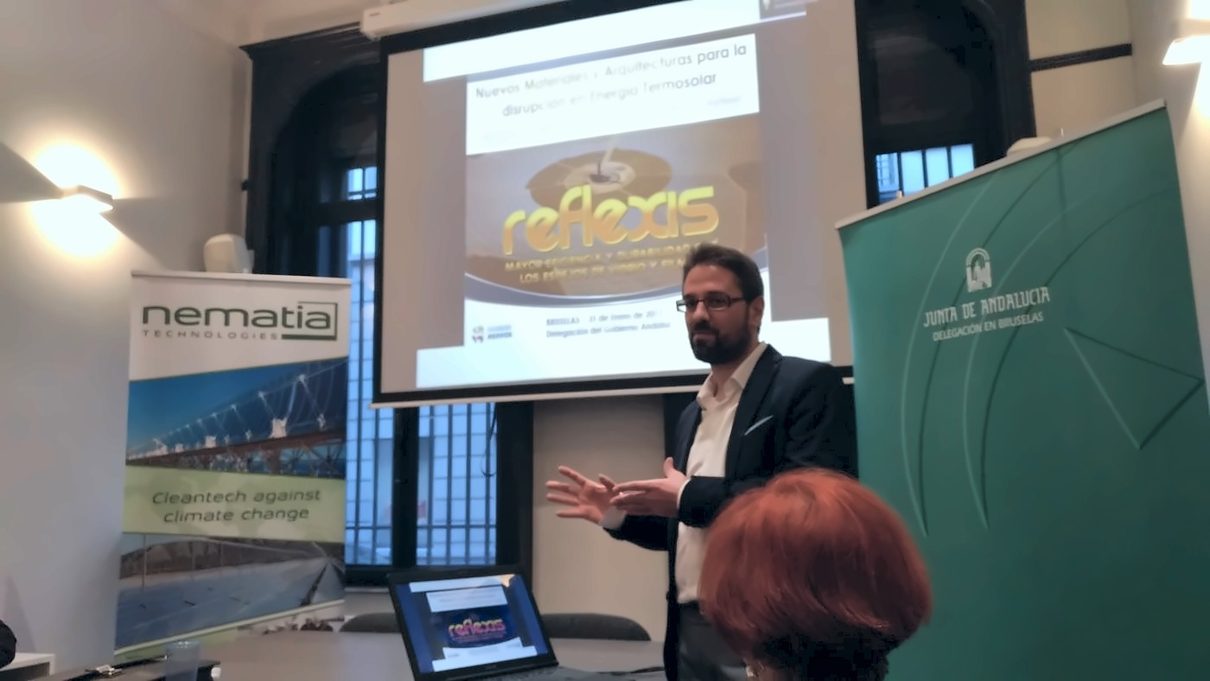
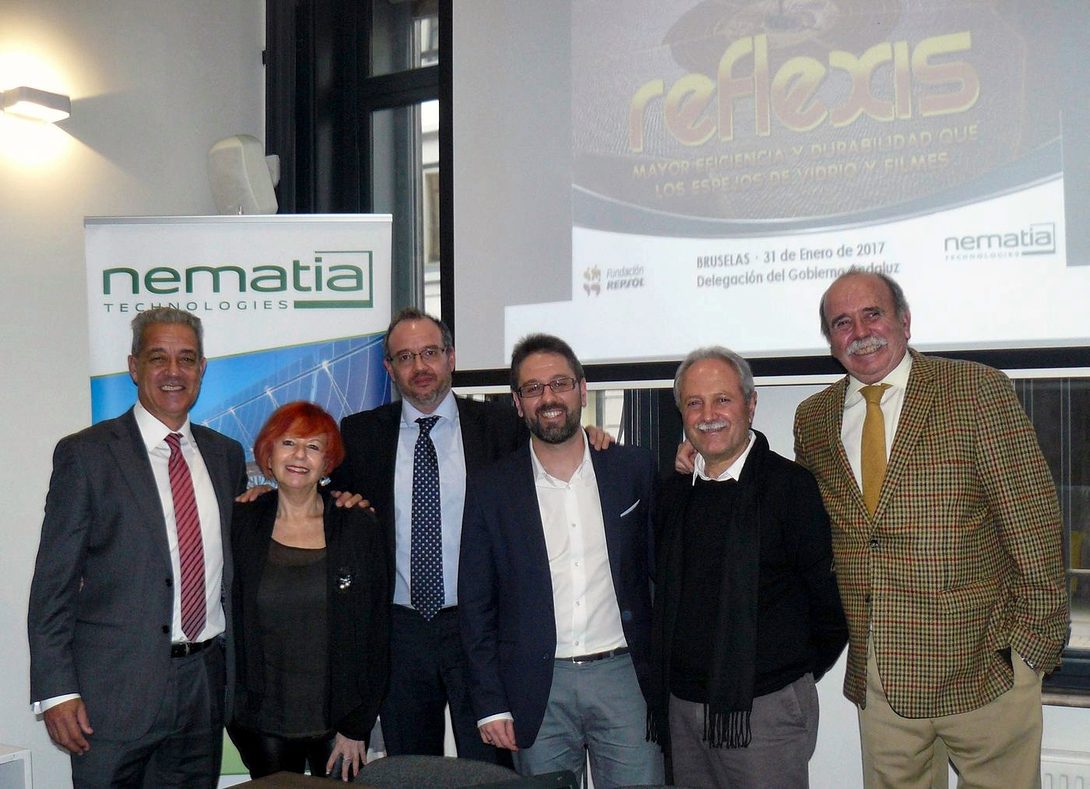
    Kick-off in BrusselsConsortium kick-off meeting. We presented REFLEXIS at the Junta de Andalucía delegation, with Fundación Repsol.

  2. JUN 2017

    The consortium in JaénWe hosted the six-month meeting.

  3. JAN 2018

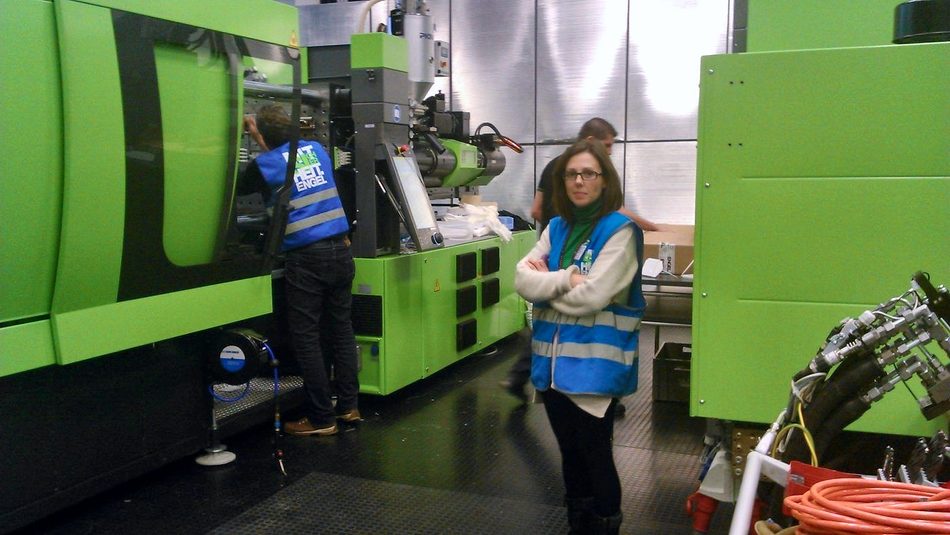
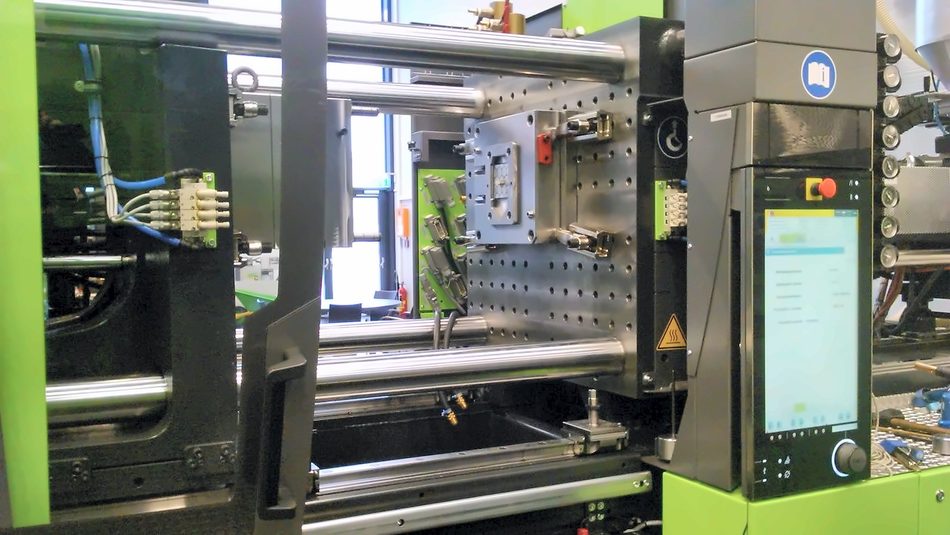
    Injection in AustriaInjection trials of the mirror at Engel and a consortium meeting in Terrassa.

  4. OCT 2018

    SolarPACES 2018Project poster at the world solar thermal conference, in Casablanca.

  5. 2019

    Industrial scale-upInjection-compression mould for the 0.50 × 0.25 m mirror and series production.

  6. JUN-OCT 2020

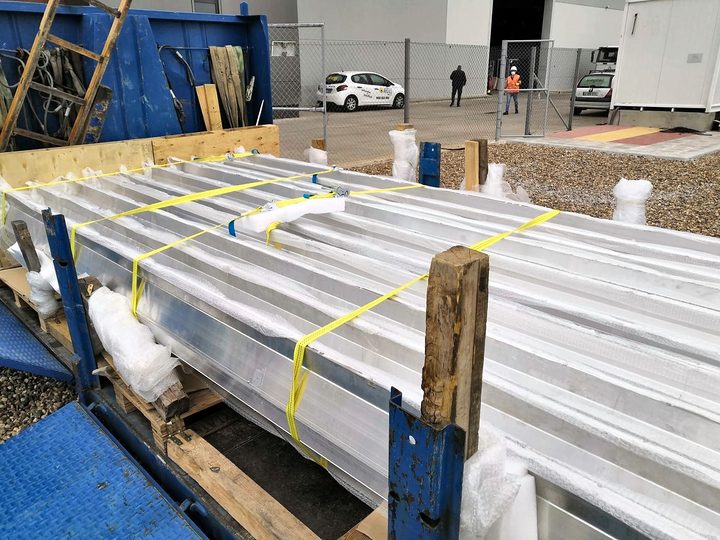
    Pilot plantIn the middle of the pandemic we shipped 840 mirrors to Seville, where they were mounted on the Fresnel collector.

  7. JUN 2021

    Close and Innovation RadarIN-POWER ended on 30 June, and the European Commission registered the polymeric mirror as our innovation in its Innovation Radar.

EU Innovation Radar · European CommissionTech ReadyMaturity level of the polymeric mirror
Key Innovator
Nematia Technologies, sole
Innovations
Two, nos. 42680 and 42684
Project
IN-POWER, Horizon 2020
Date
June 2021
See the entry on the Innovation Radar

The EU Innovation Radar is the register in which the European Commission records the most promising innovations from the projects it funds. They are identified by the experts who review each project, who also indicate which organisations are key to developing them, the “Key Innovators”, and how mature they are for the market.

From IN-POWER, the Innovation Radar registered two innovations of our polymeric mirror, one focused on solar thermal power and the other extending it to other applications. In both, Nematia is listed as the sole “Key Innovator”: the Commission registers the innovation as ours. Its maturity level, “Tech Ready”, is the one for technologies that are already advanced, at the prototype, pilot or demonstration stage, before commercialisation.

In the project’s final review, the Commission’s experts also pointed out that the polymeric mirror was possibly the IN-POWER result with the greatest exploitation potential.

The consortium, from Brussels to Madrid

MAGTEL’s pilot plant at Aerópolis (Seville)

The project on video

Still from the IN-POWER project video Video · 2:30 In Power Project LEITAT · MAGTEL · 2021

Project summary published by LEITAT in August 2021 and produced by MAGTEL. It covers the construction of the Seville pilot plant, the preparation of the Fresnel loops and the polymeric mirrors once installed.

LEITAT · 18 Aug 2021 · on-screen text in English

The consortium

  • LEITATcoordinator · ES
  • Nematia TechnologiesES
  • VottelerDE
  • KolzerIT
  • GeocadES
  • Fundación TeknikerES
  • CEAFR
  • ENEAIT
  • FertiberiaES
  • MAGTELES
  • OHL IndustrialES
Partners
11
Countries
4
Pilot plants
2
Duration
54 months
Budget
€5.82 M
EU funding
€4.99 M

The IN-POWER project received funding from the European Union’s Horizon 2020 research and innovation programme under grant agreement No 720749.

Map of western Europe with the countries of the IN-POWER partners highlighted (Spain, France, Italy and Germany), each partner’s headquarters numbered from 1 to 10 and the two pilot plants, A and B. The legend follows the map. GERMANY FRANCE ITALY SPAIN 1 2 3 4 5 6 7 8 9 10 A B
  1. 1. Terrassa · LEITAT, coordinator
  2. 2. Martos · Nematia
  3. 3. Córdoba · MAGTEL (head office)
  4. 4. Madrid · OHL Industrial and Fertiberia
  5. 5. Eibar · Fundación Tekniker
  6. 6. Irún · Geocad
  7. 7. Paris · CEA
  8. 8. Korntal-Münchingen · Votteler
  9. 9. Milan · Kolzer
  10. 10. Rome · ENEA
  11. A. Seville · MAGTEL’s Fresnel pilot plant
  12. B. Casaccia (Rome) · parabolic trough pilot plant

Nematia Space & Optics
2016-2019

Nematia Space & Optics

Mirrors for ground and space telescopes

The way of making mirrors that we brought to solar thermal power also opened the door to astronomy. A lightweight mirror that comes out of the process with its shape built in is of interest to ground-based telescopes and space missions.

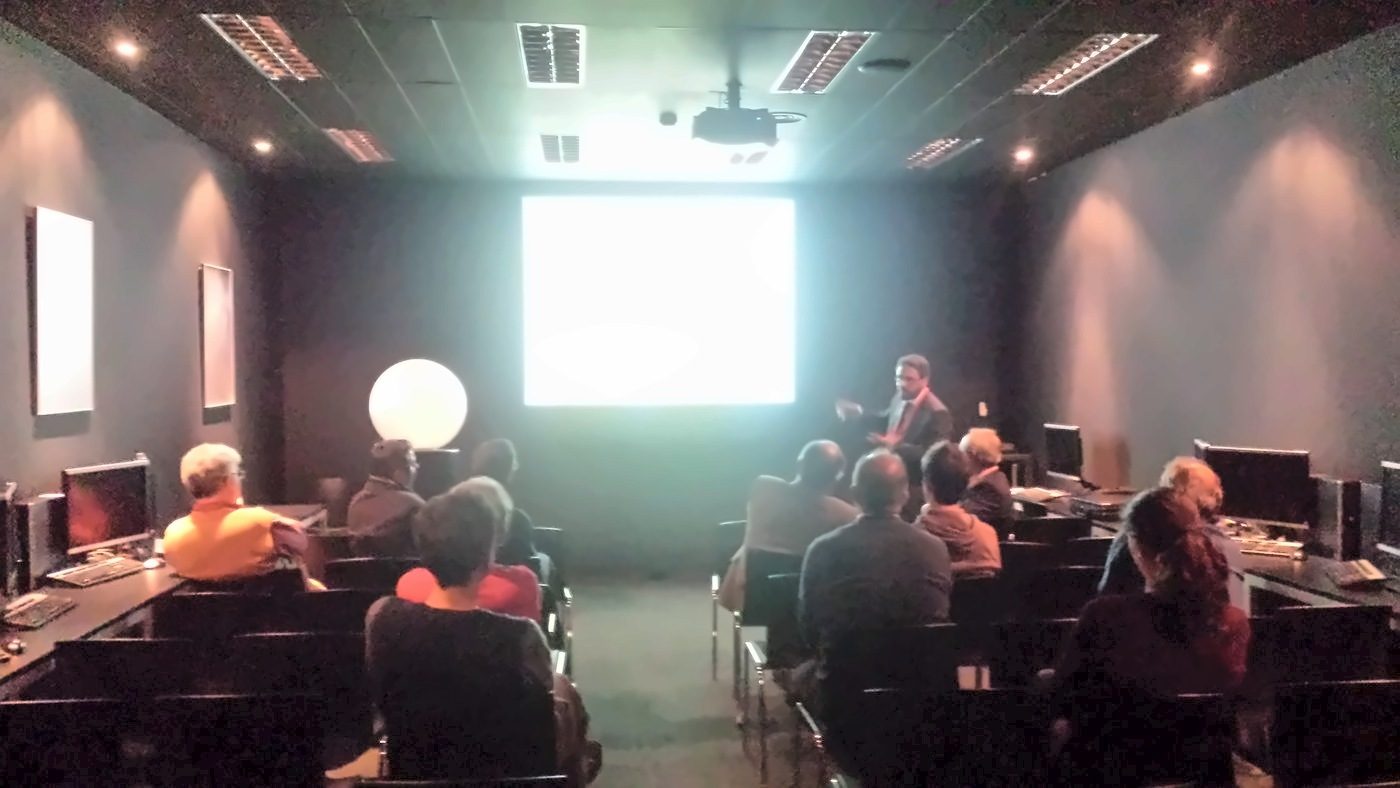
It all began on 28 January 2016, when we presented REFLEXIS at the European Space Astronomy Centre (ESAC) of the European Space Agency, in Villanueva de la Cañada (Madrid). The session was organised by Francisco Espartero, director of the Observatorio Andaluz de Astronomía, and ESA featured it on the website of its CESAR education programme with the summary “Reflexis plastic reflectors, a possible revolution for astronomy”.

That meeting led to our collaboration with a group at the Institute of Astrophysics of Andalusia (IAA-CSIC) specialising in robotic telescopes. With its researchers we proposed a 60 cm mirror for a wide-field robotic telescope dedicated to monitoring space debris and near-Earth asteroids, characterised our samples at the CSIC Institute of Optics in Madrid, and studied their application to the Cherenkov telescopes of the CTA observatory (now CTAO).

In 2017 we brought this activity together in a line of its own, Nematia Space & Optics. In 2018, with the IAA-CSIC, we prepared a proposal for a lighter mirror for the infrared telescope of THESEUS, a candidate mission of ESA’s science programme, and in 2019 we registered in ESA-STAR, the Agency’s supplier system.

Darkened room with an audience in front of a lit screen, during a talk
Our presentation of REFLEXIS at ESA’s ESAC. 28 January 2016.
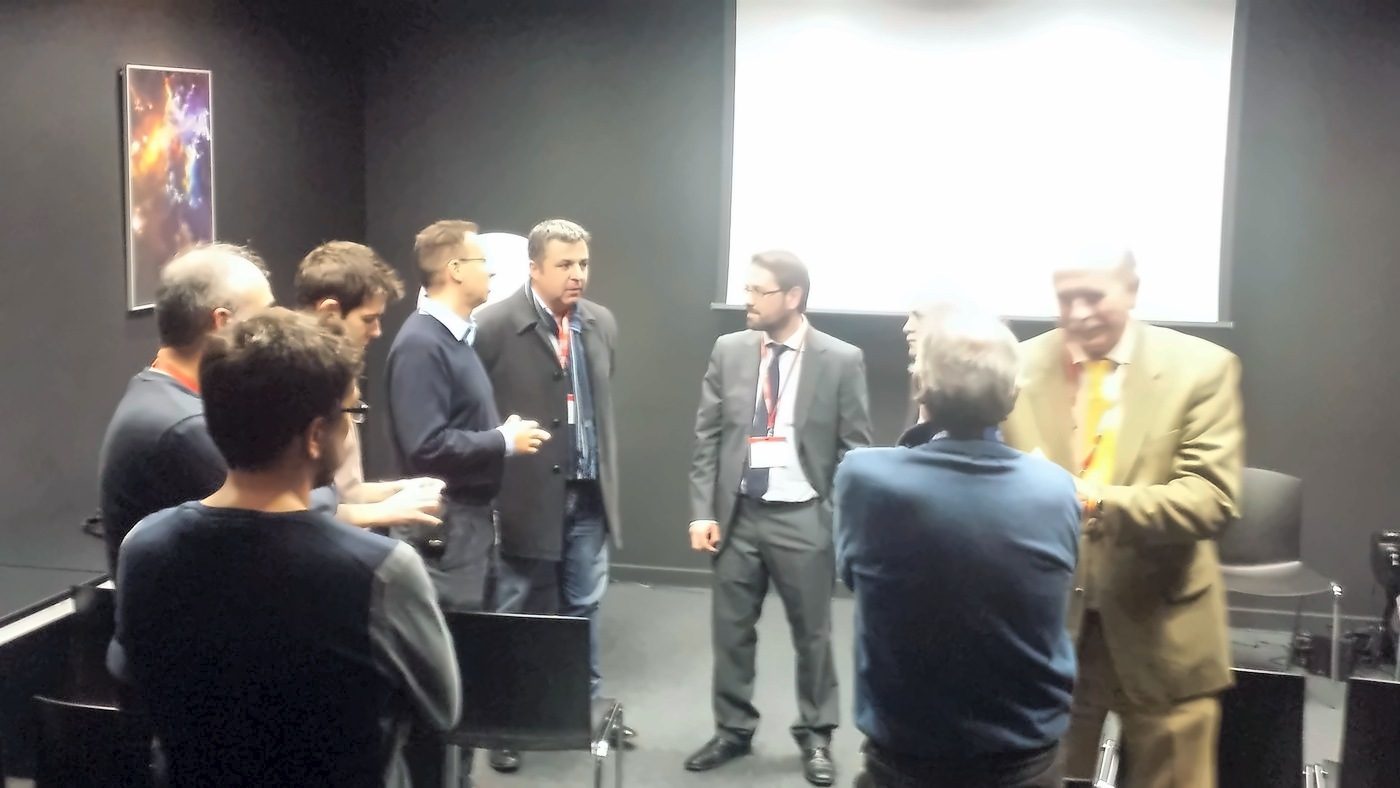
Group of people talking on their feet in a room after the talk
The discussion afterwards, on the possibilities of space observation and satellites.

Same principle, different materials

We never proposed sending the polycarbonate solar thermal mirror into space. What carries over from one application to another is the way the mirror is made, as a part that comes out of manufacturing with its optical shape, stiffness and mountings and is then metallised and protected. Materials, process and coatings depend on where the mirror works, and in a telescope or a satellite they are different.

Solar field

Solar thermal · by day · outdoors

Sun, wind, hail, sand and frequent washing for decades. It must reflect the whole solar spectrum well and be cheap per square metre.

Ground-based telescopes

Optical and Cherenkov · at night

Optical telescopes work under a dome and need a very precise shape that stays stable as the temperature changes. Cherenkov telescopes carry hundreds of facets each, in the open air with no dome to protect them, and must reflect above all blue and ultraviolet light. In both cases, the lighter the mirror, the simpler the mount.

Space

Satellites and telescopes in orbit · in vacuum

Launch vibrations, vacuum, radiation and extreme thermal cycles. Materials must not release gases that fog the optics, the shape must hold to fractions of a micron, and every kilo counts.

That is why each use has its own combination of materials, process and coating. If you are interested in the technical detail, write to us.

How a Cherenkov telescope works

Cherenkov telescope · segmented mirror · works at night, in the open air

Diagram, not to scale, of a Cherenkov telescope. A gamma ray enters the atmosphere and, at an altitude of about 20 to 10 km, produces a particle shower. The shower emits a flash of blue and ultraviolet Cherenkov light in a cone that lights up a circle about 250 m across on the ground. Inside that circle, the telescope’s mirror, made of many facets, reflects the light onto the camera at its focus, where a few pixels form the elliptical image of the shower. The flash lasts a few nanoseconds. spaceatmospheregamma ray20 km10 kmparticle showerCherenkov lightblue and ultravioletthe flash lastsa few nanosecondscameraimage of the showermirror facetsa circle of light about 250 m across Diagram, not to scale, of a Cherenkov telescope. A gamma ray enters the atmosphere and, at an altitude of about 20 to 10 km, produces a particle shower. The shower emits a flash of blue and ultraviolet Cherenkov light in a cone that lights up a circle about 250 m across on the ground. Inside that circle, the telescope’s mirror, made of many facets, reflects the light onto the camera at its focus, where a few pixels form the elliptical image of the shower. The flash lasts a few nanoseconds. spaceatmospheregamma ray20 km10 kmparticleshowerCherenkov lightblue andultravioletthe flash lasts a few nanosecondscameraimage ofthe showermirrorfacetsa circle of light about 250 m across
Not to scale. A gamma ray strikes the atmosphere and produces a particle shower that emits a flash of blue and ultraviolet Cherenkov light lasting a few nanoseconds. Hundreds of mirror facets, in the open air and without a dome, concentrate that light onto a very fast camera.
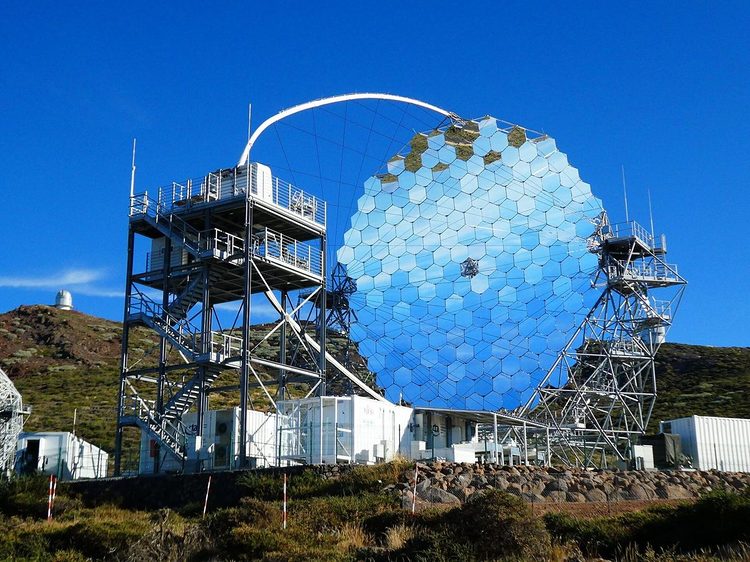
Large telescope with a mirror made of hexagonal segments, its steel structure and the arch that holds the camera, under a blue sky
The LST-1 telescope, the first large telescope of the CTAO observatory. Its mirror is made of hexagonal facets that focus the light onto the camera on the arch.
Location
Roque de los Muchachos (La Palma, Spain)
Mirror
23 m across
Facets
198
In service
since 2018
Photo: Syrio / Wikimedia Commons, CC BY-SA 4.0.

Mirrors already at work in space

  • Space telescopesHubble observes with a 2.4 m primary mirror. James Webb joins 18 segments into a 6.5 m mirror that works below −200 °C.
  • AstrometryESA’s Gaia measures the positions of more than a billion stars with two telescopes that have ten mirrors between them.
  • Earth observationThe multispectral instrument on the Sentinel-2 satellites, part of the Copernicus programme, forms its image with a three-mirror telescope.
  • Solar sailsIn 2019 LightSail 2 sailed on the push of sunlight against a 32 m² reflective sail.

Timeline of the space line

  1. JAN 2016

    ESAC (ESA)We present REFLEXIS at the European Space Astronomy Centre.

  2. FEB 2016

    60 cm mirrorWe offer the IAA-CSIC a 60 cm mirror for a wide-field robotic telescope.

  3. MAY 2016

    Cherenkov telescopesWe submit a mirror proposal for the CTA observatory to the IAA-CSIC.

  4. JUN 2016

    CSICWe characterise our samples at the CSIC Institute of Optics in Madrid.

  5. SEP 2017

    Nematia Space & OpticsWe bring the space and astronomy activity together in a line of its own.

  6. 2018

    THESEUSMirror proposal with the IAA-CSIC for an ESA candidate mission.

  7. MAR 2019

    ESA-STARWe register as suppliers to the European Space Agency.

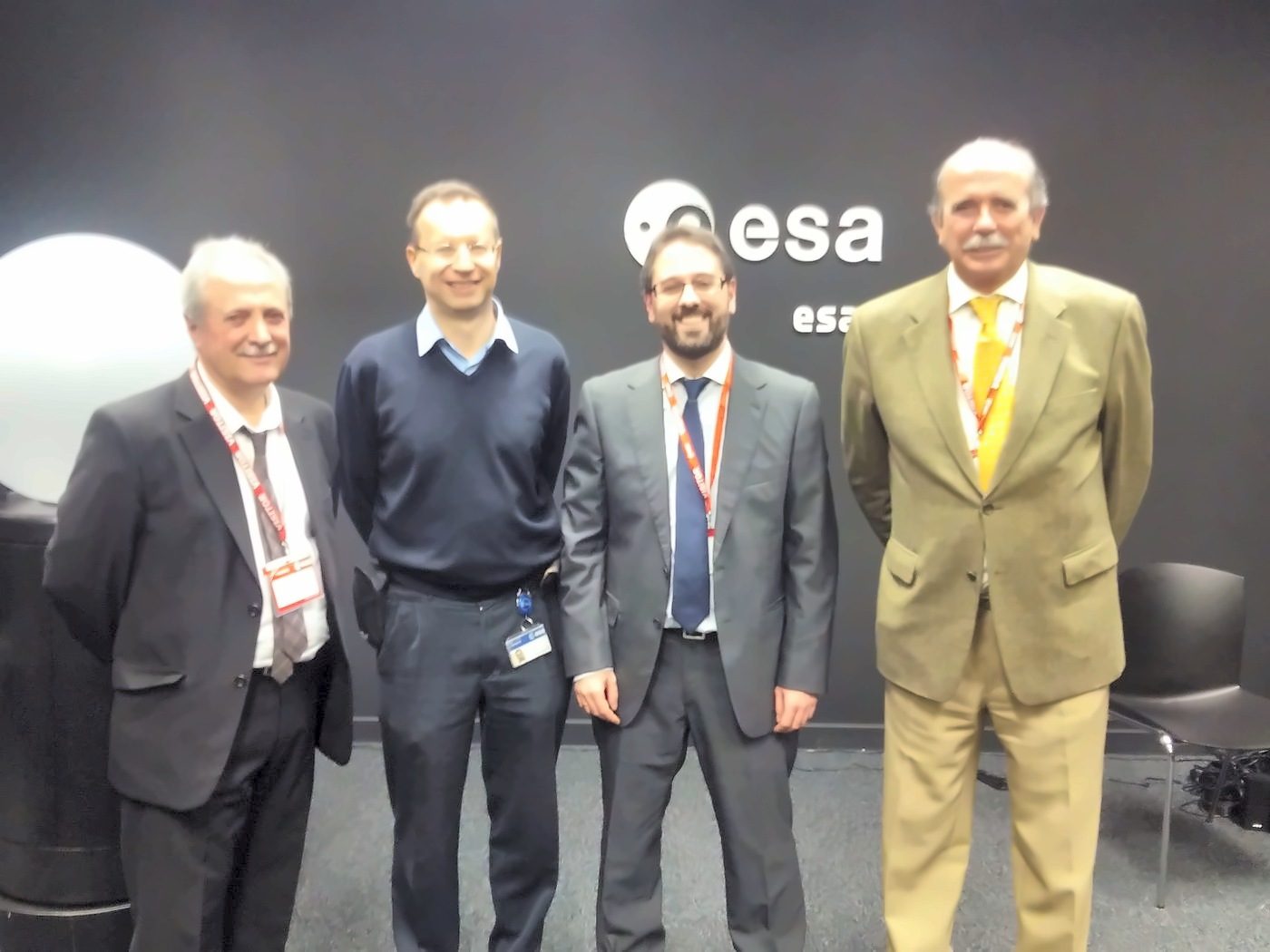
Four men pose in front of the ESA and ESAC logo
At ESAC after the presentation. January 2016.

Applications we studied

  • Lightweight primary mirrors for wide-field robotic telescopes.
  • Mirror facets for Cherenkov telescopes.
  • Lightweight optics for instruments and space missions, with materials suited to that environment.
  • Telescopes for observatories and amateur astronomers.

Engineering and training
2006-2020

Nematia Automotive Optics

End-to-end product engineering in technical plastics

Before REFLEXIS, and while we were developing it, we worked as a product and tooling engineering firm for thermoplastics. We supported the customer from the idea to the approval of the part.

  1. 01Concept and R&DFeasibility study, ideas and patents.
  2. 02Product designPart and assembly, designed for manufacturing.
  3. 03PrototypesValidation of form, assembly and function.
  4. 04ToolingMoulds, dies, inspection fixtures and poka-yoke assembly lines.
  5. 05Pre-seriesProcess set-up with the manufacturer.
  6. 06ApprovalTests and documentation for the customer.

Our technical team came from the engineering and purchasing departments of leading automotive and automotive lighting manufacturers. We worked with the most advanced design and simulation tools in the sector, and also did re-engineering of existing parts.

Sectors: automotive and automotive lighting, aeronautics, rail and marine, telephony, household appliances and furniture.

Automotive lighting. Juan Manuel Donaire, our R&D director, is the author of automotive lighting patents for high-volume models. Once at Nematia, we developed a lamp holder with an integrated flexible circuit, with a patent application in 2009 (ES2356454).

European projects. Besides IN-POWER, we took part in preparing new European R&D proposals in solar energy and in optics for space.

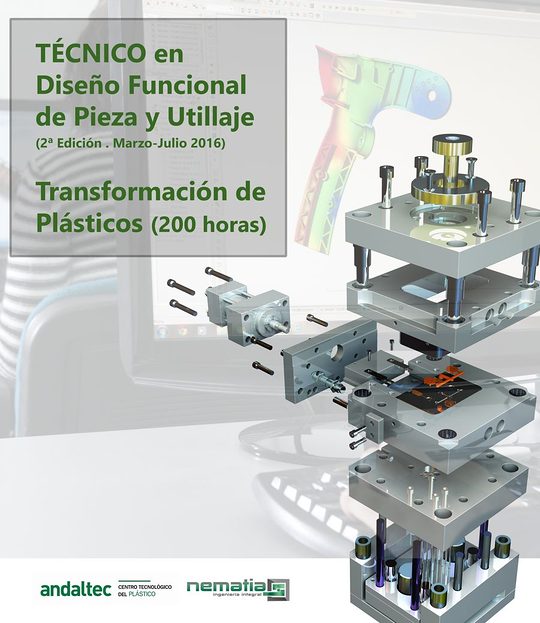
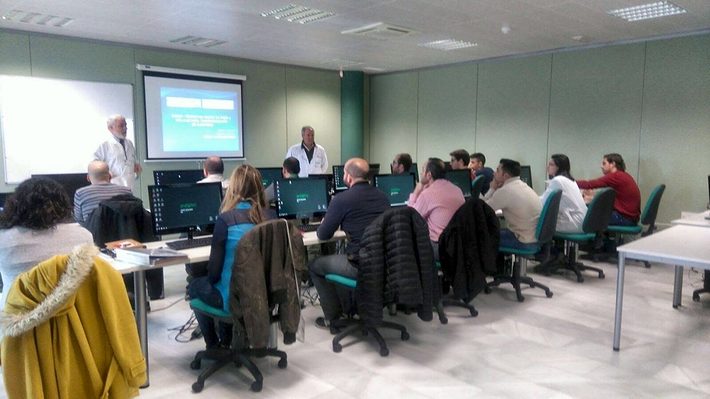
Poster for the course Functional Part and Tooling Design Technician for Plastics Processing, 2nd edition, with an exploded view of a mould Two teachers in white coats introduce the course to about twenty students sitting at their computers

Functional part and tooling design technician

Training · 2015 and 2016

With Andaltec, the Plastics Technology Centre, we organised and taught this course on part and mould design with CATIA V5. The first edition, in 2015, lasted 100 hours, and the second, in 2016, 200.

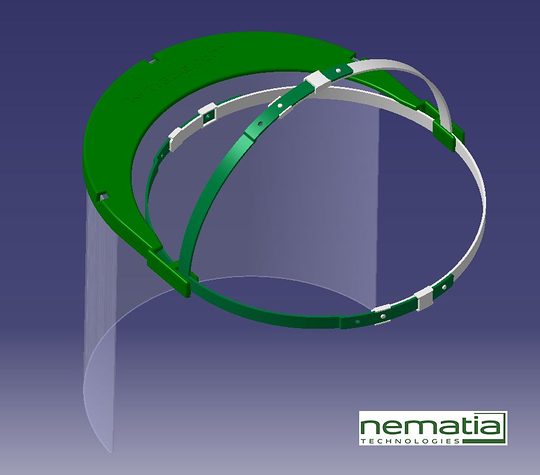
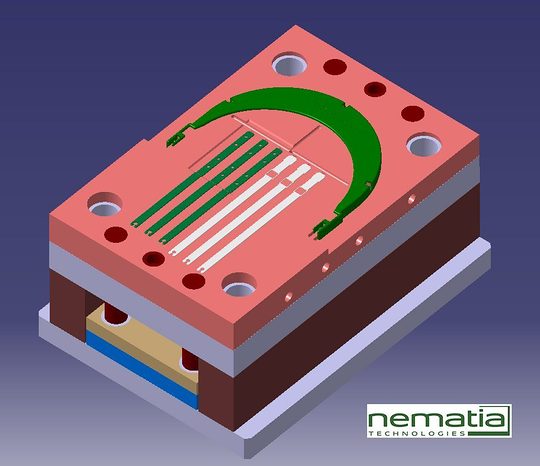
3D design of a face shield with a green headband and a transparent visor 3D design of the face shield injection mould, with the green parts in the cavity

Protective face shield and its mould

COVID-19 · Apr 2020

In the first weeks of the pandemic we designed a face shield and its injection mould, able to produce between 4,000 and 5,000 units a day, and gave the design away free so that the shields could be made and donated.

History
2006-2021

Fifteen years, from a family engineering firm to a European project

Juan Manuel Donaire Camacho founded Nematia in Martos (Jaén) with his children, Alejandro and Zayda, after more than 30 years in automotive lighting.

  1. 2006
    • Nov

      We set up Nematia Ingeniería Integral in Martos (Jaén), an engineering firm for the design and development of thermoplastic products for the automotive and aeronautics industries.

  2. 2007
    • Feb

      In Seville, we take part in the European Seventh Framework Programme day for the aeronautics sector.

    • Aug

      We register our trademark and launch our first corporate website.

  3. 2008
    • After discovering Andasol, near Guadix, Juan Manuel Donaire comes up with the idea of applying car headlamp technology to the solar mirror. This is how REFLEXIS is born.

  4. 2009
    • Jan

      We file the patents for the injection-moulded solar reflector and for a lamp holder with an integrated flexible circuit.

    • Oct

      We extend the reflector patent internationally (PCT).

  5. 2010
    • May

      We sign an engineering framework contract with a manufacturer in the rail sector.

    • Aug

      The international application for the solar reflector patent is published (WO2010086468).

  6. 2012
    • Apr

      We are granted Spanish patent ES2360777, “Reflector solar y procedimiento de fabricación”.

  7. 2013
    • Jul

      Fundación Repsol chooses REFLEXIS from 479 applications for its Entrepreneurs Fund. We are the only Andalusian company selected.

    • Sep

      The President of Jaén Provincial Council receives us and holds the project up as an example for young people.

    • Nov

      We obtain the REFLEXIS trademark and the first prize “Realidad Empresarial” at the VI Premios al Emprendimiento of the University of Jaén.

    • Dec

      We move into an office in the building of Andaltec, the Plastics Technology Centre, in Martos.

  8. 2014
    • Jan-Jun

      We receive training and mentoring at the Repsol Technology Centre, and Repsol’s Board of Directors learns about the project.

    • Jul

      MIT Technology Review’s Spanish edition publishes the project.

    • Oct

      We take part in South Summit, in Madrid.

    • Nov

      The Minister of Economy, Luis de Guindos, visits our office at Andaltec and sees REFLEXIS. Canal Sur Televisión covers the visit in its news bulletins.

    • Nov

      We receive the Premio Jóvenes Jaén from the Andalusian Youth Institute, in the Economy and Employment category.

  9. 2015
    • Feb

      The first Andaltec-Nematia course on part and tooling design begins. We present REFLEXIS at the Entrepreneurs Fund Innovation Forum.
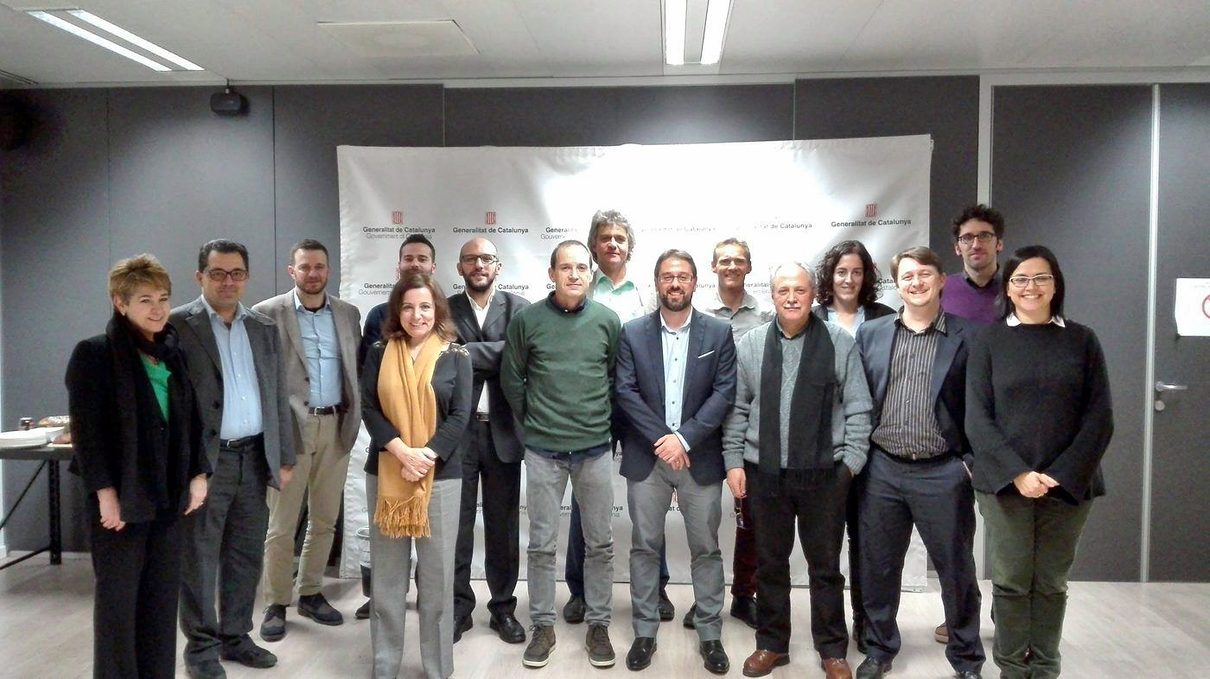
    • Apr

      The newspaper El Mundo reports how we validate the prototyping process on a small scale, with 150 prototypes.

    • May

      We receive an institutional visit from the Junta de Andalucía.

    • Jun-Dec

      We carry out the third prototype phase with industrial partners from Germany, Austria and Italy. The edge sealing passes the CASS corrosion test and we obtain sample “Z”, the best version of the mirror.

    • Dec

      REFLEXIS appears in “Juntos lo hemos hecho posible”, the Entrepreneurs Fund’s four-year report. We join the European proposal IN-POWER.

  10. 2016
    • Jan

      We take part in the Fund’s 3rd Innovation, Industry and Investment Forum, at Campus Repsol.

    • Jan

      We present REFLEXIS at ESA’s European Space Astronomy Centre (ESAC), in Villanueva de la Cañada. Our collaboration with the IAA-CSIC begins.

    • Mar-Jul

      We teach the second edition of the part and tooling design course, now 200 hours long.

    • Jun

      We characterise our samples at the CSIC Institute of Optics in Madrid, together with the IAA-CSIC.

    • Dec

      The European Commission approves IN-POWER.

  11. 2017
    • Jan

      IN-POWER kicks off in Brussels, and we present REFLEXIS at the Junta de Andalucía delegation.

    • Feb

      We change our name to Nematia Technologies. We go on a trade mission to Israel.

    • Jun

      We host the IN-POWER consortium in Jaén.

    • Sep

      We create the Nematia Space & Optics line for ground and space telescope mirrors.

    • Oct

      We join Solar Concentra, the Spanish technology platform for concentrating solar power.

  12. 2018
    • Jan

      We run injection trials of the IN-POWER mirror at Engel (Austria).

    • Apr

      Fundación Repsol invites us to tell the story of our ten years of R&D at the Repsol Technology Centre, as one of the Fund’s success stories.

    • Oct

      IN-POWER is presented at SolarPACES 2018, in Casablanca. With the IAA-CSIC we prepare a mirror proposal for THESEUS, an ESA candidate mission.

    • Nov

      We obtain the Innovative SME Seal from the Ministry of Science, Innovation and Universities.

  13. 2019
    • Mar

      We register in ESA-STAR, the European Space Agency’s supplier system.
    • We scale the mirror up to 0.50 × 0.25 m, with an injection-compression mould, and produce the series for the pilot plant.
  14. 2020
    • Apr

      We design a protective face shield against COVID-19 and its injection mould, and give the design away.

    • Jun

      We ship 840 mirrors to MAGTEL’s pilot plant in Seville.

    • Oct

      On 22 October, the installation of the mirrors begins on the pilot plant’s Fresnel collector.

  15. 2021
    • Jun

      The EU Innovation Radar registers the polymeric mirror with Nematia as sole “Key Innovator” and rates its maturity as “Tech Ready”. IN-POWER ends on 30 June.

A group of people in suits poses in front of the REFLEXIS panel with the Fundación Repsol and Nematia logos
Visit by the Minister of Economy, Luis de Guindos, to our office at Andaltec. November 2014.
The 2007 Nematia Ingeniería Integral logo above the 2017 Nematia Technologies logo
From Nematia Ingeniería Integral (2007) to Nematia Technologies (2017).
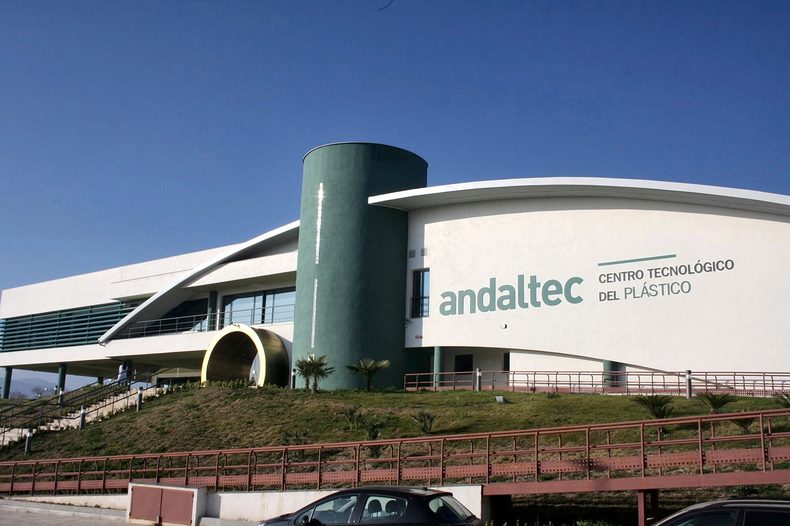
The Andaltec building, Plastics Technology Centre, with its green tower
Andaltec, in Martos, where we had our office from December 2013.
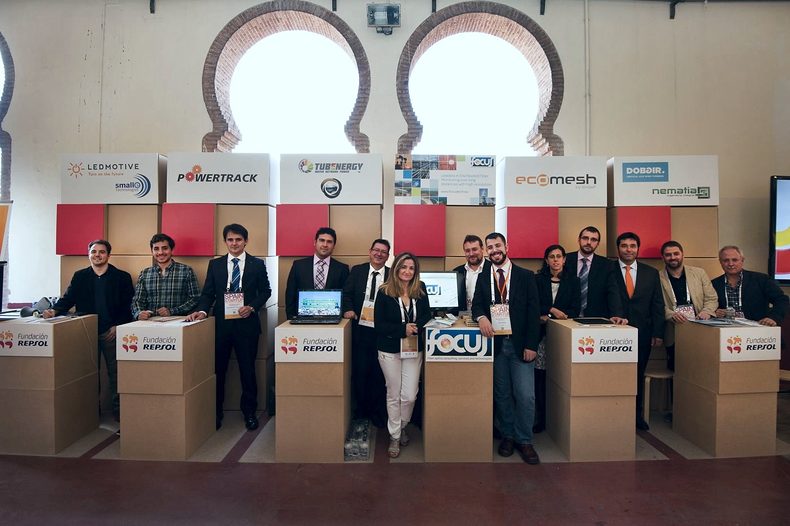
The Entrepreneurs Fund project teams pose in front of their stands in an arcaded venue
With the Entrepreneurs Fund projects at South Summit, Madrid. October 2014.
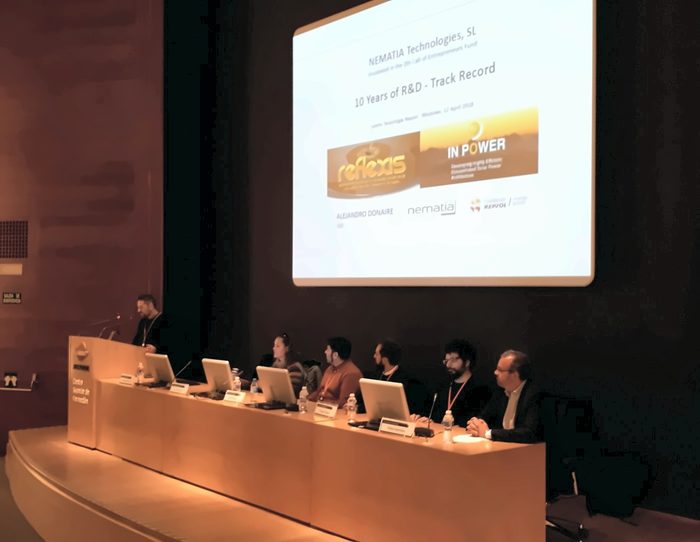
Room at the Repsol training centre with Nematia’s presentation “10 Years of R&D - Track Record” on the screen and a panel of speakers
Our talk “10 Years of R&D”, at the Repsol Technology Centre. April 2018.

Patents, awards, seals and support

Patent ES2360777

2012 · Spanish Patent and Trademark Office

“Solar reflector and manufacturing process”, filed in 2009 and granted in 2012.

International PCT extension

2009 · WIPO

International application for the same invention, filed in 2009 and published in 2010 (WO2010086468).

Entrepreneurs Fund

2013 · Fundación Repsol

One of the 8 projects selected from 479 from around the world, with incubation and mentoring between 2013 and 2015.

First prize “Realidad Empresarial”

2013 · University of Jaén

VI Premios al Emprendimiento of the University of Jaén.

Premio Jóvenes Jaén

2014 · Andalusian Youth Institute

Economy and Employment category.

TOP 500 Hello Tomorrow

2016 · Paris

Among the 500 most disruptive companies in the world in the Hello Tomorrow Challenge.

Horizon 2020

2016 · European Commission

Partners in the IN-POWER project, with €394,119 of European funding.

Members of the solar thermal sector

2017 · Solar Concentra and ESTELA

Members of Solar Concentra, the Spanish technology platform, and of its working groups, and of ESTELA, the European Solar Thermal Electricity Association.

Innovative SME Seal

2018 · Ministry of Science

Official recognition of our R&D and innovation activity, valid from 2018 to 2021.

EU Innovation Radar

2021 · European Commission

Sole “Key Innovator” for the IN-POWER polymeric mirror, with “Tech Ready” maturity.

Juan Manuel Donaire collects a trophy on a stage, to applause
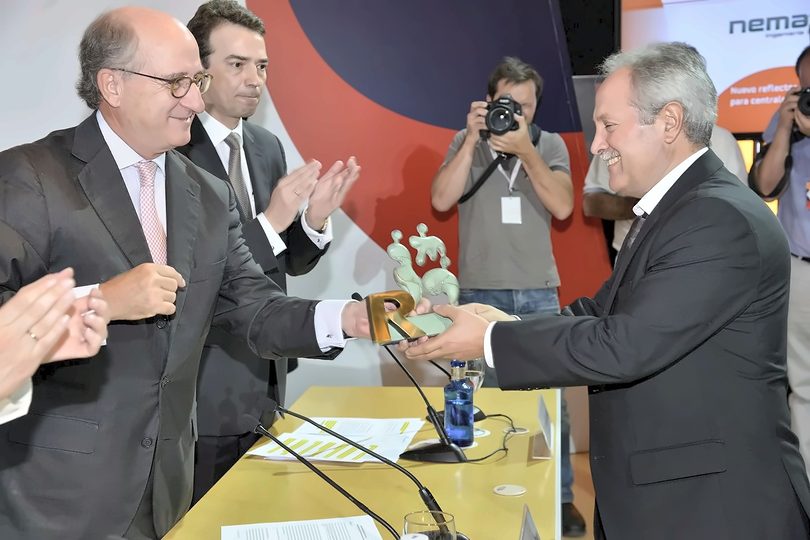
Juan Manuel Donaire collects the Entrepreneurs Fund award. July 2013.
Alejandro, Juan Manuel and Zayda Donaire smiling with a trophy
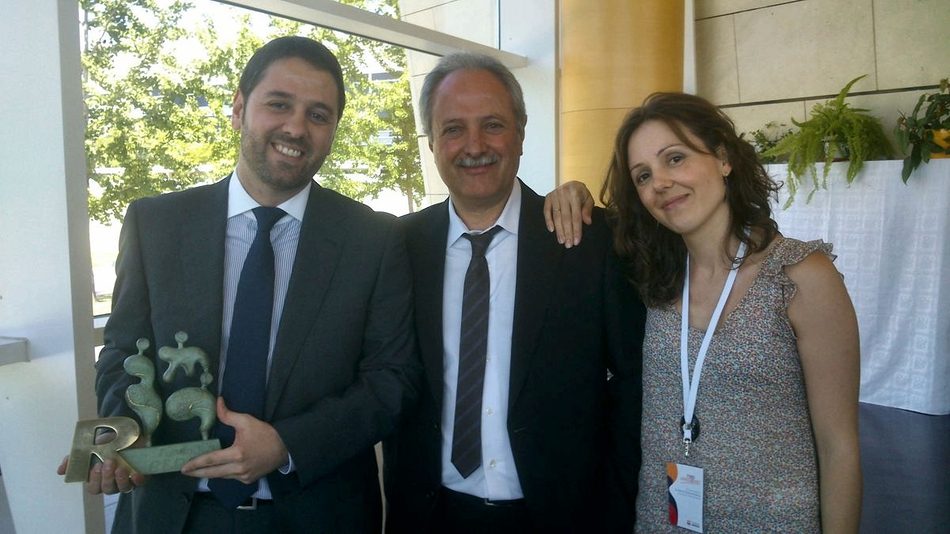
Alejandro, Juan Manuel and Zayda Donaire, with the Fund award. July 2013.
Group photo of award winners and officials on the stage of a university assembly hall
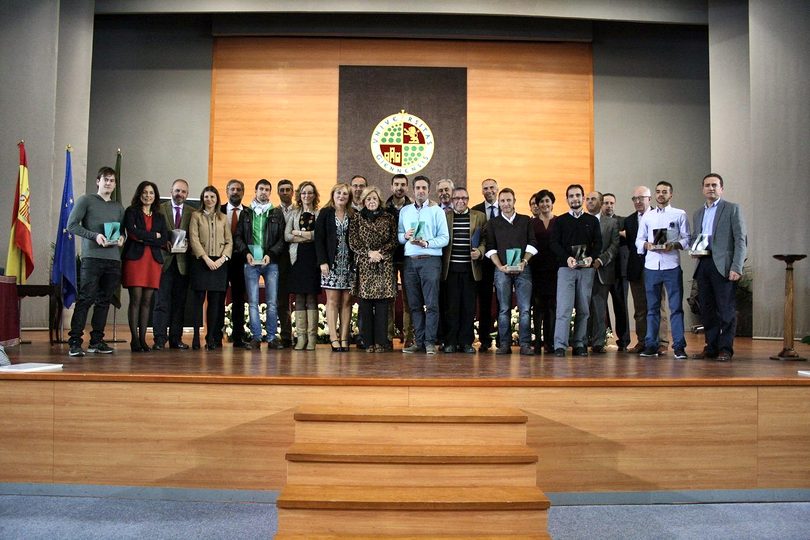
Group photo of the VI Premios al Emprendimiento. November 2013. Photo: University of Jaén.
Diploma of the University of Jaén first prize for the REFLEXIS project, next to a wooden trophy
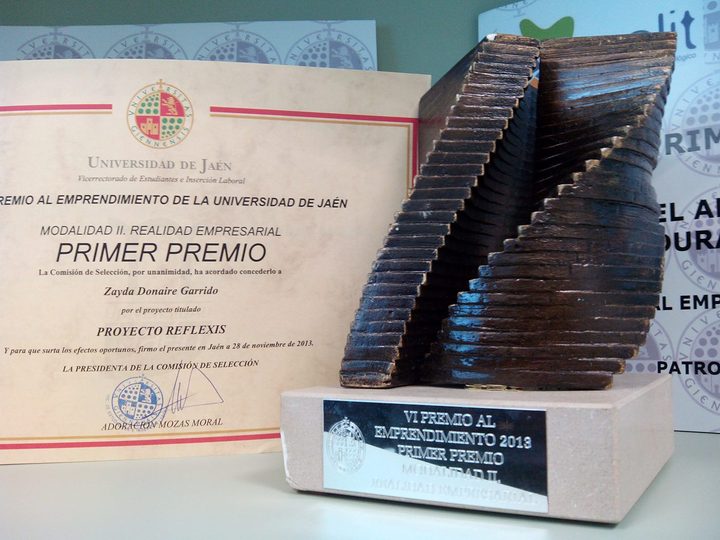
University of Jaén first prize, Realidad Empresarial category, for the REFLEXIS project.
About thirty award winners pose with their trophies in front of a Junta de Andalucía banner
Group photo of the Premios Jóvenes Jaén of the Andalusian Youth Institute. November 2014.
Innovative SME Seal of the Government of Spain, valid until 27 November 2021
Innovative SME Seal, 2018-2021.

Twelve years of R&D with the means of a microenterprise

Three people, with no laboratory of our own and few resources, taking an idea from the patent to a European pilot plant.

  1. 2009
    Patent ES2360777We filed the REFLEXIS patent, granted in 2012.
  2. 2013
    10 × 10 cm samplesFirst injection-moulded prototypes, already within the Entrepreneurs Fund.
  3. 2015
    Sample “Z”The best version of the mirror, with 95.8 % specular reflectance at 660 nm, above the reference glass.
  4. 2019
    0.50 × 0.25 m partInjection-compression mould and series production in IN-POWER.
  5. 2020
    840 mirrors, 105 m²Installed in MAGTEL’s Fresnel pilot plant at Aerópolis (Seville).

At every stage we relied on a network of partners, suppliers and laboratories in Spain, Germany, Austria, Italy and France, and on Andaltec and Fundación Repsol. With them we turned an idea from the automotive sector into a solar mirror with optics close to those of glass, passed accelerated corrosion tests, built an injection-compression mould for large parts and made hundreds of mirrors for a pilot plant.

We led two work packages of a Horizon 2020 project and its intellectual property management, and at the end of the project the European Commission registered the polymeric mirror as our innovation.

Along the way we documented the process from start to finish, with 80 recipes and versions tested and more than 2,400 laboratory measurements. We make that knowledge available to anyone who wants to take the mirror to market.

Press
2013-2021

What was published

A selection of news, videos and public documents about our work. Links marked as archive lead to the copy saved in the Internet Archive.

2016-2019

The founding team

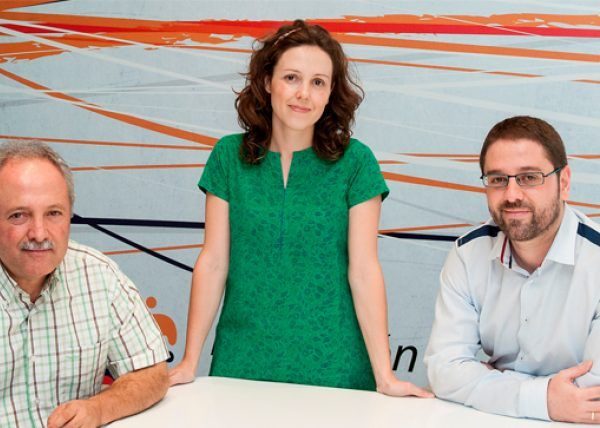
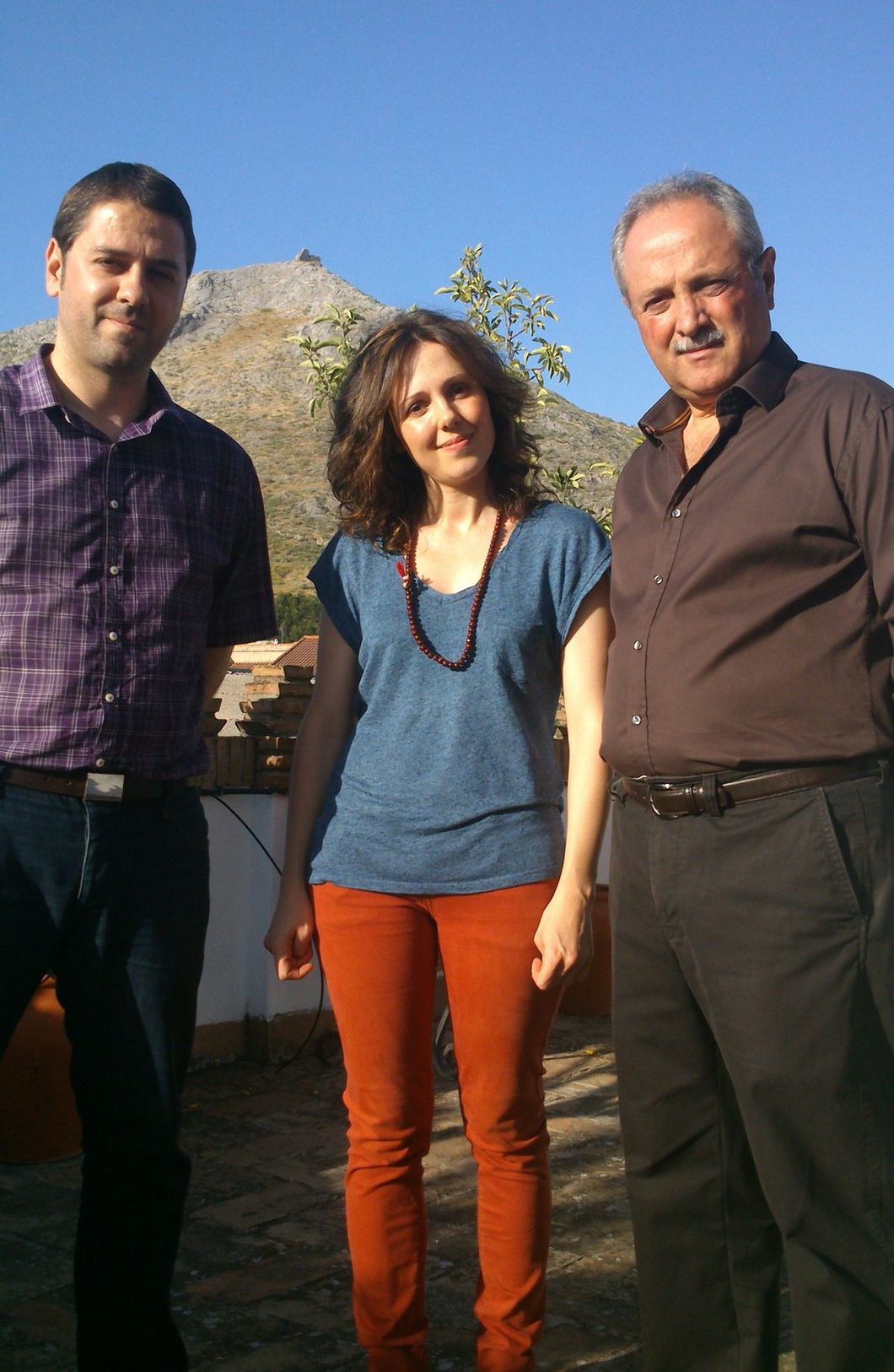
Alejandro, Zayda and Juan Manuel Donaire standing outdoors, with a hill in the background
Alejandro, Zayda and Juan Manuel Donaire. 2013.
  • Juan Manuel Donaire CamachoCo-founder and R&D director, inventor of the REFLEXIS patent. A qualified industrial master technician, he has more than 30 years in industry, mostly in automotive lighting and signalling. He has designed both the parts and the injection moulds that make them, so he conceives every part from the start to come out of the mould well. He co-designed the first robots used in Spain to automate the manufacture of headlamps and rear lamps, and he is the inventor of two international headlamp patents, for the Audi A4 and the Volkswagen New Beetle, whose exploitation rights are held by Valeo. He has worked in design from the drawing board to CATIA V5. At Nematia he defined the mirror’s configuration and manufacturing process, proposed the overmoulded coating that protects the silver and designed the REFLEXIS moulds. In IN-POWER he designed the mirror, from the sample to the large part, and how it is fixed to the collector structure.
  • Alejandro Donaire GarridoCo-founder and chief executive during the incubation in the Entrepreneurs Fund and the IN-POWER project. He holds a degree in Law and did postgraduate studies at the universities of Granada and Complutense in Madrid. A lawyer specialising in industrial property and in financial and tax law, at Nematia he handled the company’s management and planning, its legal, tax and accounting matters and business development. In IN-POWER he directed, for Nematia, the two work packages we led, on the mirror and on the solar field, and represented the company, together with Zayda, in the consortium’s General Assembly. He was also the consortium’s IPR manager, responsible for its intellectual property, and a member of its exploitation committee.
  • Zayda Donaire GarridoCo-founder and quality and commercial manager. She holds a University Expert diploma in environmental management from the University of Granada and is trained in quality and environmental management systems. Before Nematia she worked in the automotive supplier industry in Martos. In REFLEXIS she was in charge of the test plan to validate the prototype and of relations with laboratories and suppliers. In IN-POWER she represented Nematia, together with Alejandro, in the consortium’s General Assembly, and the two of them presented progress on the work packages we led at the project meetings. She also prepared reports and deliverables with the team, coordinated shipments and tests with the coating suppliers and with the centres that measured the mirrors, and handled standardisation.

Technology transfer

REFLEXIS and its IN-POWER evolution, available to an industrial partner

We offer the process knowledge, data and designs of REFLEXIS and of the mirror we developed in IN-POWER, which go far beyond what was published in the patent, for transfer, licensing or co-development.

Process know-how

Injection and injection-compression moulding of the substrate, metallisation, overmoulding and edge sealing, documented step by step.

Data

80 recipes and versions, more than 2,400 laboratory measurements, spectra and actual development schedules.

Designs

Sample moulds and 0.50 × 0.25 m part moulds, fixtures and masks.

Support

Technical assistance from the founders to adopt the technology.

Formats and audience

  • Co-development with an industrial partner to take the mirror to market.
  • Licensing of the technical know-how or transfer of the technology’s assets.
  • We are reaching out to manufacturers of concentrating solar collectors and integrators of solar heat for industry, industries with a high demand for process heat, manufacturers and processors of technical plastics, optical coating companies, technology centres, manufacturers of reflectors and technical lighting, and venture capital funds.

From pilot to factory, with an industrial partner

We are looking for an industrial partner or an investor who wants to take the polymeric mirror to market. If that is you, write to us and we will give you more details about the technology and how we can work together.

  1. InventionPatent filed in 2009 (ES2360777)
  2. PrototypesSamples validated in the laboratory
  3. Scale-up0.50 × 0.25 m part made in series
  4. Pilot plant840 mirrors in a Fresnel collector